 how-to
How to Verify Car Repair Quotes: A Line-by-Line Guide
Table of Contents
- Start With a Written, Itemized Estimate
- Verify the Diagnosis Before You Verify the Price
- Check Labor Hours and the Labor Rate
- Check Parts Pricing and Part Types
- How to Compare Mechanic Quotes Side by Side
- Questions to Ask a Mechanic Before Approving Repairs
- Car Repair Estimate vs. Final Bill: What Changes and Why
- Frequently Asked Questions
Last Updated: October 18, 2026
Start With a Written, Itemized Estimate
A written, itemized estimate is the most important document in any auto repair transaction. It lists every repair, part, and fee so you can check each charge instead of trusting one lump sum.
At Kerner's Auto, we hand customers an itemized estimate before we touch a wrench. If a shop will not put the numbers in writing, you cannot verify car repair quotes, and the document is useless if the final bill changes.
Ask for the estimate by email or text. A verbal "about $900" is a guess with no accountability.
The Line Items Every Estimate Needs
A complete estimate should include:
- Your vehicle details: year, make and model, plus the VIN
- The complaint: what you told the shop, in your words
- The diagnosis: what the technician found and how they tested it
Missing any of these? Ask for a revised estimate. A shop that resists is telling you something.
Verify the Diagnosis Before You Verify the Price
The price only matters if the diagnosis is right. A cheap quote for the wrong repair is the most expensive outcome.
Ask the technician what failed, what test proved it, and what happens if you wait.
A common mistake is collecting three quotes without confirming all three shops found the same problem.
If two shops disagree, ask each what test led to its conclusion.
Check Labor Hours and the Labor Rate
Labor is where estimates quietly grow. You pay the hourly rate and the number of hours billed, and both deserve a check.
The Labor Rate: What You Are Actually Paying For
The labor rate is the shop's posted hourly charge. It varies by location and shop type, and dealerships often charge more than independents.
Ask two or three local shops for their posted labor rate on the same day. You want a rate in line with the local market: far below can signal a shop that makes up the difference elsewhere, and far above deserves an explanation.
Labor Hours: Compare Billed Time to a Published Guide
Labor hours are the expected time for the job, usually pulled from a published labor time guide, the same reference many shops and insurers use. Ask the advisor to show you the labor time for each job and which guide it came from.
A timing belt job that books at a set number of hours should not bill double. If a line item is far above the guide time, ask why, severe rust, a seized fastener, or a prior repair that changed the procedure are legitimate answers; "that's just what it takes" is not.
How Overlapping Labor Works
If two repairs share the same disassembly, you should not pay full labor twice. Replacing a water pump and timing belt on the same engine is the classic example: the front comes apart once, so the second job should bill at reduced time.
Ask the advisor: "Do any of these jobs share labor, and does the estimate reflect that?" A good shop explains the overlap and adjusts. Billing every job at full standalone time on a shared disassembly is either disorganized or padding the bill.
How Vehicle Complexity Changes the Number
Labor guides account for the vehicle, not just the repair. The same job on a transverse four-cylinder and a V6 can book very different hours, and AWD, turbocharged, and hybrid models often add time. That is why "the same repair" on two vehicles is not comparable, and why the estimate should list your VIN and exact trim.
A Practical Labor Check
You do not need a repair manual to spot an inflated number:
- Ask the advisor to show the labor time for each job and its guide
- Compare the hours to another written estimate for the same vehicle
- Question any job billed far above the rest
Check Parts Pricing and Part Types
Parts are the second big variable, and type matters as much as price. A line that says "brake pads" or "alternator" without a brand, part number, and grade is a placeholder, not a verifiable line. Turn each parts line into a decision you can defend.
The Four Part Grades and What They Trade Off
Every parts line falls into one of four grades, each with a different balance of price, fit, warranty, and safety.
- OEM (original equipment manufacturer): Made by or for the vehicle manufacturer to the same specification as the part that came on the car. Highest fit and consistency, usually the highest price, and warranty terms that follow the manufacturer's parts policy. Best default for safety-critical and electronic components where calibration and tolerances matter.
- Aftermarket: Made by a third-party supplier. Quality ranges from excellent to disposable, so the brand is the whole story. A reputable aftermarket brand can match OEM performance at a lower price; an unbranded part is a gamble. Ask for the brand name and, where possible, the part number.
- Remanufactured: A used core that has been disassembled, cleaned, worn components replaced, and tested to a specification. Often the value pick for alternators, starters, and compressors. The warranty is usually stated by the remanufacturer, so ask for it in writing.
Neither OEM nor aftermarket is automatically better: OEM costs more and fits exactly, while a quality aftermarket part can save money on an older vehicle. The problem is an estimate that does not say which you are getting, because then the shop makes the trade-off, not you.
How to Verify a Parts Line
A checkable parts line has four elements: part name, grade (OEM, aftermarket, remanufactured, or used), brand, and part number. With those you can price the same part at a retailer or the manufacturer's parts site.
Ask these questions on every parts line:
- Is this part OEM, aftermarket, remanufactured, or used?
- What brand is it, and do you have the part number?
- Does it carry a warranty, and for how long, parts only, or parts and labor?
That last question matters more than most drivers realize. Alternators, starters, compressors, and some pumps carry a core charge, a deposit built into the price, refunded only if the shop returns the old unit.
Where Part Choice Affects Safety and Warranty
Part grade is not only a budget decision. On safety-critical systems, brakes, steering, suspension, airbags, and ADAS sensors, the wrong grade can affect performance and calibration. On a vehicle still under manufacturer warranty, an aftermarket part in a covered system can complicate a future claim, so check the warranty terms first.
A shop that lists "brake pads" with no brand or type is hiding the decision from you. You should make that call, not discover it after the fact.
How to Compare Mechanic Quotes Side by Side
Comparing car repair quotes line by line is the only fair method. Totals mislead, because one quote may include a service the other leaves out or use a cheaper part grade to look better.
Build a comparison sheet: repairs down the left, shops across the top, with parts type, labor hours, and price for each. Then compare like with like.
| What to compare | Shop A | Shop B | What to check |
|---|---|---|---|
| Diagnosis | Fault code plus road test | Code only | Which is backed by evidence |
| Parts type | OEM | Aftermarket | Warranty and fit |
| Labor hours | Per line item | Bundled | Overlap and inflation |
| Shop supplies | Itemized fee | Flat fee | What it covers |
| Diagnostic fee | Credited to repair | Charged separately | Total out-the-door |
| Warranty | Stated in writing | Verbal only | Get it in writing |
A Worked Example: Two Quotes for the Same Job
Say two shops both quote a water pump replacement on the same vehicle. Shop A lists an OEM pump, shows labor hours, adds a small supplies fee, and credits the diagnostic fee. Shop B quotes a lower total but lists an unbranded aftermarket pump, bundles labor into one number, and charges the diagnostic fee on top. Shop B looks cheaper until you compare parts grade and the diagnostic fee, then the gap shrinks or reverses.
Questions to Ask a Mechanic Before Approving Repairs
The right questions turn a quote into a conversation. Ask them before you sign the repair authorization.
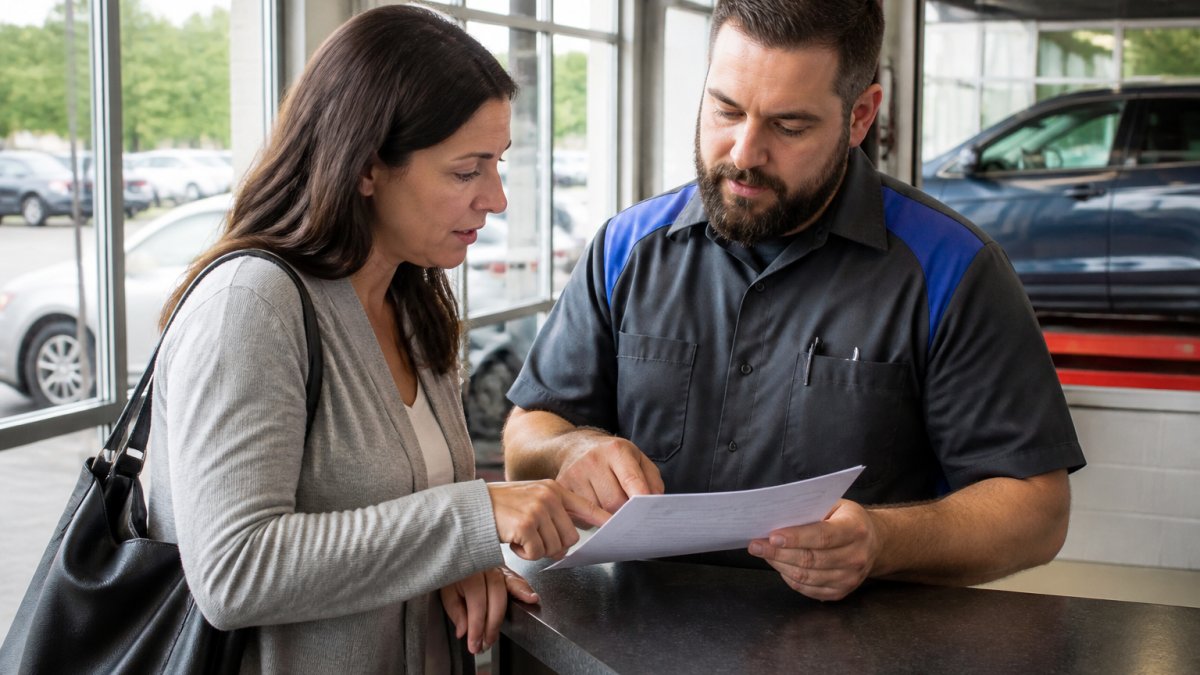
Here is the list we would want a customer to ask us:
- What test confirmed this diagnosis?
- Which of these repairs are urgent, and which can wait?
- Are the parts OEM, aftermarket, or remanufactured?
- What is the warranty on parts and on labor?
- Is the diagnostic fee credited toward the repair?
- Will you call me before doing any additional work?
- What is the total out-the-door price, including tax and fees?
Question six matters most. A shop that calls before extra work protects you from surprise charges. Get that promise in writing on the authorization.
Car Repair Estimate vs. Final Bill: What Changes and Why
A car repair estimate is a good-faith projection, and the final bill can differ. Rusted bolts, a part that fails on removal, or a hidden problem found mid-job are legitimate reasons for a change.
The difference between a fair shop and a risky one is consent. Fair shops call, explain the change, and get approval first. Risky shops do the work and hand you a bigger bill.
Watch for these red flags and pressure tactics:
- A quote that jumps well beyond the estimate with no call
- "Today only" pricing that rushes your decision
- Refusal to put the estimate or warranty in writing
A guaranteed price in writing, a clear quote validity period, and a phone call before any additional work are the three habits that separate a trustworthy shop from a risky one.
Frequently Asked Questions
How do I know if a car repair quote is fair?
Compare the quote against two or three others for the same written diagnosis. Check the labor rate against local shop rates, confirm the labor hours match the job, and verify parts pricing for the part type listed. A fair quote is itemized, states whether parts are OEM or aftermarket, and puts a validity period on the price. If a shop will not put the numbers in writing, treat that as a reason to keep looking.
What should a car repair estimate include?
A complete estimate lists the diagnosis, every recommended repair as its own line, parts by name and type, labor hours and the labor rate, shop supplies, diagnostic fees, taxes, and the total. It should also show the quote validity period and note any work that is recommended but not urgent. Anything lumped into a single total without a breakdown is hard to verify, so ask for the itemized version before you approve.
What should I do if the final bill is higher than the estimate?
Ask for a line-by-line explanation of what changed. Legitimate increases usually come from additional work you approved after a call, or from a repair that revealed a related problem once the vehicle was apart. In most states, shops need your authorization before doing work beyond the estimate. If you were not contacted, request the written authorization record and compare it to the final invoice before paying.
Can you get accurate car repair quotes online?
Online estimators are useful for a rough range, not a verified price. They rely on your make and model, year, and ZIP code, and they cannot see your actual vehicle or confirm the diagnosis. Use them to spot a quote that looks far outside the norm, then have the shop put its own findings in writing. AI quote-checking tools can flag missing line items, but they cannot validate whether the repair is needed at all.
Verifying car repair quotes takes an hour of your time and can save you real money. At Kerner's Auto, our ASE-certified technicians put every estimate in writing, itemize parts and labor, and call you before any additional work begins. With nine bays, loaner cars, and flexible financing through Synchrony Car Care, we make the honest option the easy one. Make an appointment and see the difference a transparent estimate makes.