 How-to
7 Causes of Car Shaking When Braking at Speed
Quick Summary
A car shakes braking at high speed most often because of uneven brake rotors, which cause the pads to grab and release unevenly. Out-of-balance tires, bent wheels, sticking calipers, and worn suspension parts can also cause it. Shaking felt through the steering wheel usually points to the front brakes or tires.
- Uneven rotor surfaces are the most common cause, not literally warped rotors.
- Thickness variation and lateral runout are measurable conditions a technician can check.
- Check hub runout before installing new rotors, or the vibration can return.
- Stop driving and arrange a tow if the pedal sinks, the car pulls hard, or a warning light is on.
- Steering wheel shake usually points to front brakes, front tires, or front wheels.
Table of Contents
- What Shaking During Braking at High Speed Usually Means
- Is It Safe to Keep Driving a Car That Shakes When You Brake?
- Step 1: Note When and How the Shaking Happens
- Step 2: Check the Brake Rotors for Thickness Variation and Runout
- Step 3: Rule Out Tire Balance, Tire Wear, and Wheel Damage
- Why Does My Steering Wheel Shake When I Brake at High Speeds?
- Step 4: Inspect Calipers, Pads, and Suspension Components
- Booking a Brake Inspection at Kerner's Auto
- Frequently Asked Questions
What Shaking During Braking at High Speed Usually Means
Last Updated: November 21, 2026
A car shakes when braking at highway speed is one of the most common complaints drivers bring to a repair shop. The cause is usually one of a few mechanical issues. If you suspect this, see how Kerner's Auto Service handles wheel alignment and brake-related issues.
Shaking can also come from the tires and wheels. An out-of-balance tire or a bent wheel can cause vibration that only shows up at speed, and braking makes it worse. A sticking brake caliper or worn suspension parts can add to the problem.
Many drivers assume their rotors are "warped" when the car shakes braking hard from speed. The term is common, but it is not quite accurate. A rotor usually does not bend the way the word suggests.
Here is what the shaking often feels like:
- Steering wheel shake: points to front brakes, front tires, or front wheels
- Pedal pulsation: usually points to the brake rotors or pads
- Whole-car shake: can point to tires, wheels, or suspension parts
- Shaking only above a certain speed: often points to tire or wheel balance
Is It Safe to Keep Driving a Car That Shakes When You Brake?
Mild shaking is not always an emergency, but it is never just a comfort issue.
Stop driving and arrange a tow if you notice any of these:
- The brake pedal sinks toward the floor, feels spongy, or requires pumping to stop
- The car pulls hard to one side under braking, especially if it did not before
- You hear grinding or metal-on-metal scraping when braking
- The shaking is severe enough to affect steering control or make the car feel unstable
- You smell burning, see smoke from a wheel, or notice a wheel that is much hotter than the others after a short drive
- A red brake warning light is on
Those signs can indicate a serious brake problem, and a highway stop can go wrong quickly. Do not test a soft or sinking pedal at speed.
You can usually drive cautiously to a shop, avoiding highway speeds and hard stops, if:
- The shaking is mild and only appears during braking from highway speed
- The pedal feels firm and the car stops in a straight line
- There is no grinding, no pull, and no warning light
- The vibration has been stable rather than getting worse each trip
Even in that milder group, shorten the timeline. Vibration that starts as a nuisance can wear tires unevenly, accelerate pad and rotor wear, and mask a caliper that is beginning to stick.
If you are unsure which group you are in, treat it as the urgent group and have the car looked at before the next highway trip.
Step 1: Note When and How the Shaking Happens
Before a technician can find the cause, they need clear details. Your notes can save diagnostic time and help narrow the list of likely causes.
Pay attention to these points:
- Speed: Does it start at 40 mph, 60 mph, or only above 70 mph?
- Braking type: Is it light braking or hard braking?
- Where you feel it: Steering wheel, brake pedal, seat, or the whole car?
- Road conditions: Does it happen on long downhill grades or only on certain roads?
- Recent work: Did you recently replace tires, rotors, pads, or get an alignment?
Write these details down or record a short video of the symptom if it is safe to do so. Bring your notes to the shop. A specific description like "steering wheel shakes at 65 mph when braking from highway speed" is far more useful than "my car shakes."
Step 2: Check the Brake Rotors for Thickness Variation and Runout
Brake rotors are the most common source of braking vibration, but the popular explanation, "my rotors are warped", is misleading. A cast-iron rotor rarely bends into a banana shape.
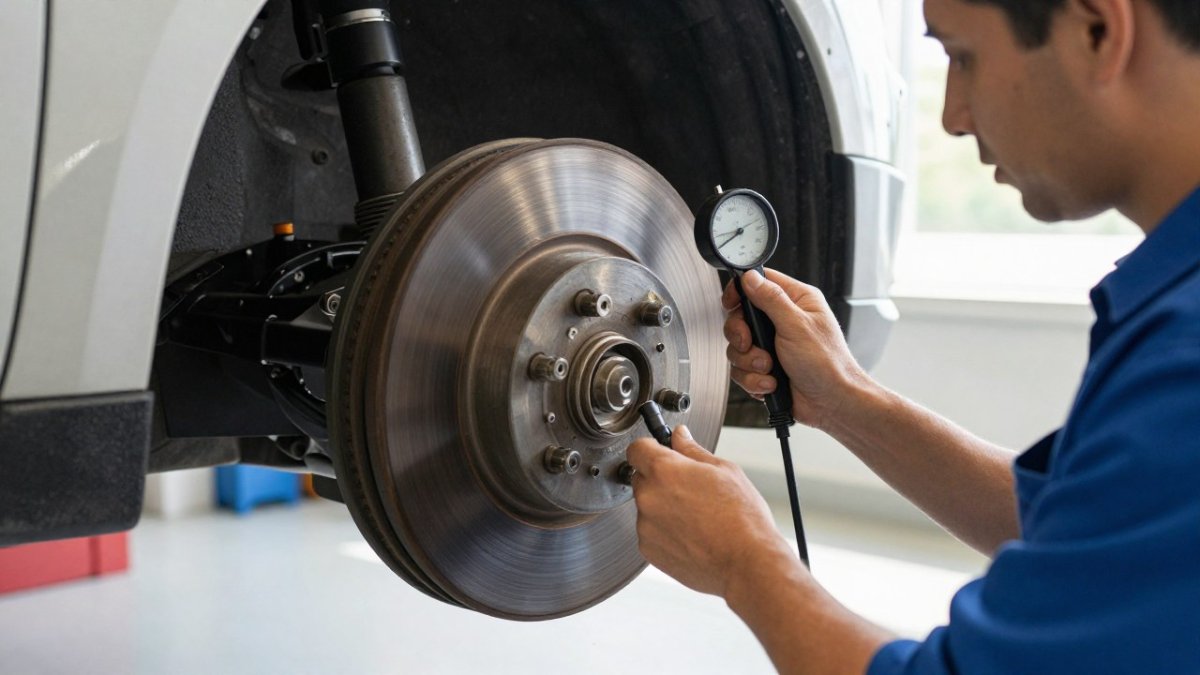
Thickness variation (DTV). The rotor is slightly thicker in some spots than others, often by only a few thousandths of an inch. Because a dragging caliper can cause uneven rotor wear and thickness variation, recognizing the signs of failing brake calipers can help explain why the pedal pulses under braking.
Lateral runout. The rotor face wobbles side to side as it spins, like a plate that is not sitting flat.
A technician confirms both conditions with measuring tools, not a visual glance:
- Rotor thickness is checked with a micrometer at several points around the face, usually at roughly 45-degree intervals, and compared against the manufacturer's minimum thickness stamped on the rotor. The difference between the highest and lowest reading is the thickness variation.
- Lateral runout is checked with a dial indicator mounted on the knuckle or a magnetic base, with the probe riding on the rotor face while the wheel is spun. Most manufacturers publish a maximum allowable runout, commonly in the range of a few thousandths of an inch, and a reading above that points to a hub, rotor, or installation problem.
- Hub runout is checked with the rotor removed, because a dirty or out-of-true hub will transfer its wobble to any new rotor bolted to it. Skipping this step is a common reason a fresh rotor starts pulsing again within a few thousand miles.
Watch out: Replacing rotors without cleaning the hub face and checking hub runout can reproduce the same vibration on new parts, so the measurement step matters as much as the parts.
The article distinguishes two measurable rotor conditions and the tools used to check them.
| Condition or check | What it is | Tool or method |
|---|---|---|
| Thickness variation | Rotor thicker in some spots than others | Micrometer at points around the face |
| Lateral runout | Rotor face wobbles side to side | Dial indicator on the knuckle or magnetic base |
| Hub runout | Hub wobble transferred to new rotors | Check with rotor removed |
| Thickness reference | Compare readings to manufacturer minimum | Minimum thickness stamped on rotor |
Step 3: Rule Out Tire Balance, Tire Wear, and Wheel Damage
Not all braking shake comes from the brakes. Tires and wheels can cause vibration that only shows up at certain speeds, and braking can make it feel worse.
Check these items:
- Tire balance: A tire with uneven weight may vibrate at highway speeds. Balancing usually fixes this. You can book wheel alignment or tire service in Shelby Township to have it checked.
- Uneven tire wear: Cupping, feathering, or flat spots can cause vibration and noise.
- Bent wheels: A pothole or curb strike can bend a wheel. A bent wheel often causes a wobble that shows up at speed.
- Loose lug nuts: Wheels that are not tightened correctly can cause shaking and are a safety risk.
A simple test is to see whether the shaking happens when you accelerate at the same speed without braking. If it does, the tires or wheels are more likely the cause. If it only happens during braking, the brakes are more likely to blame. Many shops will road test the vehicle to confirm this.
Watch out: Do not assume the cause is the brakes just because the shaking happens when you brake. A tire balance problem can seem worse during braking, so a full inspection avoids paying for the wrong repair.
Why Does My Steering Wheel Shake When I Brake at High Speeds?
When the steering wheel shakes during braking, the front of the car is usually involved. The most common cause is uneven front brake rotors. Front brakes do most of the work when you stop, so they are often the first to show wear or uneven surfaces.
Other front-end causes include:
- Out-of-balance front tires
- A bent front wheel
- Worn steering or suspension parts, such as tie rod ends or ball joints
- A sticking front brake caliper that causes uneven pad contact
Steering wheel shake that gets worse at higher speeds often points to tire or wheel balance. Shake that comes only when braking points more toward the rotors or pads. A technician can usually tell them apart with a road test and a hands-on inspection.
Step 4: Inspect Calipers, Pads, and Suspension Components
If the rotors and tires check out, the next place to look is the braking hardware and suspension. These parts can cause uneven braking forces or allow movement that feels like vibration.
Here is what a technician will look at:
- Brake calipers: A caliper that sticks can keep pressure on one side of the rotor. This causes heat, uneven wear, and pulling.
- Brake pads: Pads that are worn unevenly, glazed, or contaminated with oil or grease can cause shaking.
- Shocks and struts: Worn units can let the wheel bounce, which may feel like vibration during braking. You can browse local suspension repair options for shocks and struts.
- Ball joints, tie rods, and bushings: Loose or worn parts can allow wheel movement that shows up under braking.
- Wheel bearings: A worn bearing can cause play in the wheel and add to the shaking.
Suspension and steering problems often come with other symptoms. Listen for clunks over bumps, watch for uneven tire wear, and notice any steering drift. These clues help narrow the diagnosis.
Booking a Brake Inspection at Kerner's Auto
If your car shakes when you brake at speed, a proper inspection is the fastest way to find the cause. Kerner's Auto's advanced diagnostic services can help identify the cause so you know what needs attention.
Bring your notes about when and how the shaking happens. You can also schedule a digital vehicle inspection to confirm the cause before any repairs. That information helps our technicians start the diagnosis faster. You can make an appointment with Kerner's Auto.
Frequently Asked Questions
Is it normal for my car to shake when I brake at high speeds?
No. Shaking that appears when you brake from highway speeds is a sign that something in the braking or rolling system needs inspection. The most common causes are rotors with uneven thickness or lateral runout, tire or wheel imbalance, and sticking calipers or worn suspension parts. The shaking usually grows more noticeable as speed increases because the wheels rotate faster and any imbalance or rotor irregularity produces a stronger vibration. A technician can confirm the source with a road test and a few measurements, so there is no need to guess.
Why does my car shake when I brake from 60 to 80 mph?
Between 60 and 80 mph, wheel rotation is fast enough that small irregularities become easy to feel through the brake pedal, steering wheel, or seat. A rotor that has uneven thickness or a surface that is not flat can pulse each time the pads grip it. Tire imbalance or a bent wheel can also cause vibration that only appears during braking because the added load changes how the tire and suspension respond. Noting the exact speed range and where you feel the shake helps narrow the cause.
Can warped brake rotors cause a car to shake?
Yes, but the term warped is often used loosely. Most rotors that cause pulsation have thickness variation, meaning the friction surface is not the same thickness all the way around, or lateral runout, meaning the rotor wobbles as it turns. Neither usually means the metal has literally bent from heat. Both can be measured with a micrometer and a dial indicator. A shop that measures these values can tell you whether the rotor should be resurfaced or replaced.
Is it safe to drive a car that shakes when braking?
Driving with mild shaking that you have confirmed is limited to the brakes is generally possible for short trips, but it should not be ignored. Shaking can signal overheated brakes, a sticking caliper, or a wheel problem, and any of those can reduce braking performance. If the shaking is severe, the car pulls to one side, you smell burning, or the pedal feels soft, stop driving the car and have it towed or inspected promptly.