 How-to
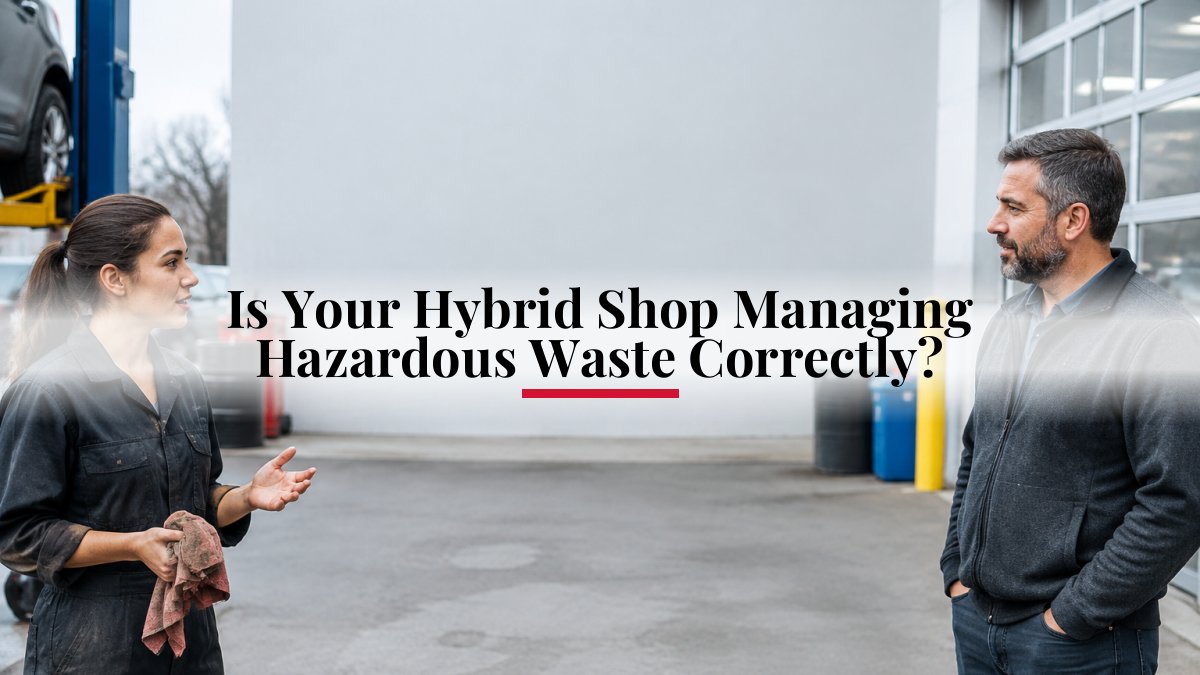
Is Your Hybrid Shop Managing Hazardous Waste Correctly?
Last Updated: November 15, 2026
Quick Summary
Managing hybrid shop waste starts with identifying every stream that leaves your bays, since the high-voltage battery is only part of the picture. Classify each stream, confirm your generator status, and label and date every container before disposal. Route each high-voltage pack by its documented condition before it leaves your lot.
- Hybrid waste includes high-voltage packs, cables, inverters, battery cooling fluid, and thermal management parts.
- Federal identification uses listed wastes and four characteristics: ignitability, corrosivity, reactivity, and toxicity.
- Keep every container closed, use compatible containers, and mark the accumulation start date.
- Use an authorized transporter and complete a hazardous waste manifest for each shipment.
- Keep a battery log with chemistry, condition, handler, and manifest number for every pack.
Table of Contents
- What Hazardous Waste Does a Hybrid Shop Actually Generate?
- Waste Identification and Classification: Is It Hazardous?
- Generator Status: Which EPA Rules Apply to Your Shop?
- Hazardous Waste Storage and Labeling Done Right
- Hazardous Waste Disposal for Businesses: Manifests and Transporters
- Hybrid Battery Disposal: A Decision Tree for Damaged and Spent Packs
- Building an Inspection-Ready Waste Workflow for Hybrid Shops
- Schedule Hybrid Service and Waste Compliance Support at Kerner's Auto
- Frequently Asked Questions
What Hazardous Waste Does a Hybrid Shop Actually Generate?
If your shop services hybrids, you already handle more hybrid shop waste than you think. Managing hazardous waste in hybrid shops starts with knowing exactly what leaves your bays, because the high-voltage battery is only part of the story.
Conventional Waste Streams Every Shop Handles
Every automotive repair facility generates waste that carries rules:
- Used oil from oil changes and engine work
- Parts-washing solvent and cleaning chemicals
- Spent filters soaked in oil or fuel
None of these are new. What changes with hybrids is volume and mix.
Hybrid-Specific Streams: High-Voltage Batteries and More
Hybrid vehicles add their own waste streams. The big one is the high-voltage battery pack, which may be lithium-ion or nickel-metal hydride.
Other hybrid-only items include:
- High-voltage cables and connectors
- Inverter and converter components
- Battery cooling fluid
Watch out: a swollen or cracked pack is not scrap metal. Treat it as hazardous until you confirm otherwise.
For a full picture of what your facility needs before you touch these systems, see our guide to hybrid vehicle repair shop requirements.
Waste Identification and Classification: Is It Hazardous?
Waste identification is the step where shops get cited most often, and hybrid shops face a harder version of the problem because several hybrid streams do not map cleanly onto the conventional automotive categories.
Waste classification means matching each stream to a listed category. The EPA sets the federal framework, and your state may add its own rules on top.
The Federal Framework in Brief
Federal hazardous waste identification runs on two tracks:
- Listed wastes, wastes the EPA has named on one of its lists (F, K, P, and U lists) (the EPA).
- Characteristic wastes, wastes that exhibit one of four characteristics: ignitability, corrosivity, reactivity, or toxicity (the EPA). A waste can be hazardous by characteristic even if it is not on a list.
Hybrid-Specific Classification Questions
For each hybrid stream, work through these questions and write down the answer:
- High-voltage battery packs, chemistry, condition, and state of charge all affect classification. An intact pack routed to a recycler may travel under a different lane than a damaged pack. Confirm with your state agency and your receiving facility rather than assuming one route.
- High-voltage cables and connectors, copper and aluminum with insulation and shielding. The metal value is real, but contaminated insulation and connector housings can push the stream into a regulated category. Segregate them from general scrap.
- Inverter and converter components, power electronics often contain capacitors, rare-earth magnets, and small amounts of regulated metals. Do not assume they are e-waste; confirm with your handler.
Watch out: the most common classification error in hybrid shops is treating a damaged pack or a mixed battery-components bin as general scrap. Once a regulated item is commingled with scrap, the entire container can be reclassified, and the paperwork you need to prove otherwise is gone.
A Jurisdiction-Aware Checklist
Federal guidance is the floor, not the ceiling. Before you finalize any classification, confirm:
- Does your state regulate the stream more strictly than the federal framework?
- Does your state offer a streamlined pathway (universal waste, recycling exemption) for any hybrid stream?
- Does your local air or water authority impose separate requirements on storage or discharge?
Document your answers for every stream and keep them with the container records. Inspectors ask for them, and a written classification record is the difference between a citation and a closed file.
Generator Status: Which EPA Rules Apply to Your Shop?
Generator status decides how much paperwork, storage time, and training your shop needs. The EPA sorts generators by how much hazardous waste they produce each month (the EPA).
Most small shops land in the small quantity generator category. Bigger operations may qualify as a large quantity generator with stricter rules.
Your status affects:
- How long you may store waste
- Labeling and recordkeeping duties
- Employee training requirements
Check your numbers monthly. One busy month can move you into a stricter tier.
Hazardous Waste Storage and Labeling Done Right
Storage and labeling failures for hybrid shop waste are the easiest violations to spot and the easiest to prevent. Get these two habits right and most inspections go smoothly.
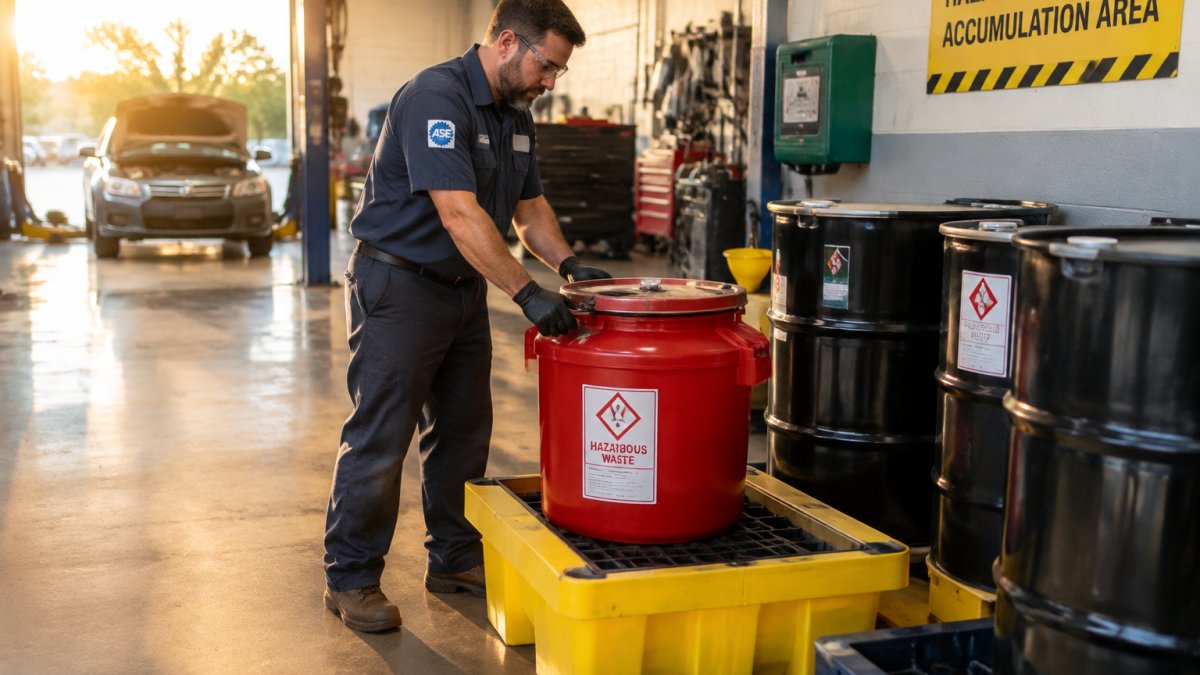
Rules for hazardous waste storage and labeling:
- Keep every container closed unless you are actively adding waste
- Use compatible containers that will not react with the contents
- Apply a hazardous waste label with contents and hazards
Spill prevention means a spill kit within reach, plus a written spill response step every tech knows.
Hazardous Waste Disposal for Businesses: Manifests and Transporters
Hazardous waste disposal for businesses is not a DIY job. Regulated waste must move through the right channels, with paper to prove it.
Follow this sequence:
- Confirm your waste is classified and labeled.
- Use an authorized transporter only.
- Complete a hazardous waste manifest for each shipment (the EPA).
- Keep signed copies for your recordkeeping file.
- Track the waste to its final destination.
Skipping the manifest is a serious problem. It is your proof the waste went where it should.
Hybrid Battery Disposal: A Decision Tree for Damaged and Spent Packs
Hybrid battery disposal is the single stream where hybrid shops diverge most from conventional shops, and it is also where the general automotive hazardous-waste guides stop short. Because the pack’s condition determines its disposal route, documenting that assessment alongside the rest of your hazardous-waste decisions helps keep each step accountable, a discipline McNeil Safety Consulting connects to broader disposal compliance.
Start by separating the pack from the vehicle and from other waste. Do not stack packs, do not store them on wooden pallets, and do not park them against a wall where a thermal event could spread. A common pattern is a dedicated quarantine area with non-combustible flooring, a clear label, and no other combustibles within a defined radius.
Step 1: Assess the Pack's Condition
Before you classify or route a pack, document four things:
- Chemistry, lithium-ion or nickel-metal hydride. The two have different recycling pathways and different thermal risks.
- Physical state, intact, swollen, cracked, punctured, or leaking. Any breach moves the pack out of the reuse and recycling lanes.
- State of charge, a fully charged damaged pack is a higher fire risk than a discharged one. Many handlers ask for packs to be discharged to a specified level before pickup, but confirm with your handler rather than assuming.
Step 2: Route by Condition
- Intact, undamaged, and still serviceable? Consider reuse, a core return to a remanufacturer, or resale to a qualified buyer. Keep the assessment record, a future buyer or handler will ask for it.
- Spent but undamaged? Route to a recycler that specifically handles lithium-ion or nickel-metal hydride packs. General scrap metal recyclers are not the right destination.
- Damaged, swollen, or leaking? Isolate it, treat it as hazardous until a qualified handler confirms otherwise, and arrange pickup through a handler experienced with damaged packs.
Watch out: a swollen or breached pack is not scrap metal and is not a core. Treating it as either is the most common routing error we see, and it can void a transporter's acceptance and expose the shop to liability for the pack's final disposition.
Step 3: Confirm the Regulatory Lane Before Pickup
Federal rules do not treat all spent batteries the same way. Federal rules do not treat all spent batteries the same way, and the applicable lane depends on the battery type and on your state's rules. Confirm the correct federal and state pathway with your state environmental agency before any pack leaves your shop.
Confirm three things before the truck arrives:
- Whether your state treats the pack as universal waste, hazardous waste, or a separately regulated stream.
- Whether the receiving facility will accept the pack in its current condition.
- Whether the transporter is authorized for the pack's DOT hazard class, damaged lithium-ion packs have specific shipping requirements that a general waste hauler may not meet.
Step 4: Document the Chain
Keep a battery log for every pack that leaves the shop: chemistry, condition, assessment date, handler, manifest or bill of lading number, and final destination.
If you are weighing repair against replacement, our guide on how to repair a hybrid car battery safely covers the handling side. Readers who want a qualified provider can also review finding reliable hybrid car service.
Route each high-voltage pack by its documented condition before it leaves your lot.
| Pack condition | Route | Key note |
|---|---|---|
| Intact, undamaged, serviceable | Reuse, core return, or resale | Keep the assessment record |
| Spent but undamaged | Recycler handling lithium-ion or NiMH | General scrap metal recyclers are not the right destination |
| Damaged, swollen, or leaking | Isolate and arrange pickup via experienced handler | Treat as hazardous until confirmed otherwise |
| Fire or crash damaged | Quarantine, observe, get expert guidance | Confirm transporter and facility accept it |
Building an Inspection-Ready Waste Workflow for Hybrid Shops
An inspection-ready workflow ties every step together, from the bay to the manifest. Shops that run both conventional and hybrid vehicles need one process that covers both.
Here is our checklist:
- Inventory every waste stream, hybrid and conventional
- Classify each stream and keep the paperwork
- Confirm generator status each month
- Label containers and mark start dates
A repeatable process beats a scramble every time. Our EV maintenance checklist helps you fold hybrid steps into routine service.
Schedule Hybrid Service and Waste Compliance Support at Kerner's Auto
Handling hybrid waste correctly takes the right process and the right partner.
Kerner's Auto has served drivers since 1973 with ASE-certified technicians and a state-of-the-art facility.
Get started with Kerner's Auto and keep your hybrid running right. Make an appointment when you are ready.
Hybrid systems and their waste streams are not something to guess at. Whether you need a diagnosis or a second opinion, our ASE-certified team can help.
Frequently Asked Questions
What hazardous waste is generated in a hybrid auto repair shop?
Hybrid shops generate the same streams as conventional shops, including used oil, parts-washing solvents, antifreeze, brake fluid, spent filters, contaminated rags, and aerosol cans, plus hybrid-specific items. The hybrid additions are high-voltage lithium-ion battery packs, damaged modules, and coolant from battery thermal systems. Each stream needs its own container and label.
How should a hybrid shop store and label hazardous waste?
Store waste in compatible, closed containers in a designated accumulation area with secondary containment. Label each container with the words Hazardous Waste, the specific contents, and the accumulation start date. Keep satellite containers closed except when actively adding waste. Inspect the area weekly and log the results. Hybrid battery packs should sit in a dry, ventilated spot away from other flammables, and damaged packs need immediate isolation.
How should damaged or end-of-life hybrid batteries be handled?
Start with a decision tree: intact packs that may still hold value can go to a remanufacturer or salvage buyer, spent packs go to a recycler, and damaged or swollen packs are treated as hazardous and isolated immediately. Never store a damaged pack indoors near other waste. Use a qualified transporter and keep the manifest on file.
Does OSHA regulate hazardous waste in auto repair shops?
OSHA regulates worker safety around hazardous materials, not waste disposal itself. That means your team needs training on chemical hazards, PPE, and emergency response under OSHA's hazard communication and bloodborne pathogen standards where applicable. The EPA and your state environmental agency govern waste identification, storage, and disposal under RCRA. A hybrid shop needs to satisfy both: safe handling for technicians and compliant disposal for the waste.