 ultimate-guide
How to Choose a Mechanic: 7 Steps for 2026
Table of Contents
- Step 1: Start With ASE Certification and Credentials
- Step 2: Check Online Reviews and the Shop's Reputation
- Step 3: Ask These Questions to Ask a Mechanic Before Repair
- Step 4: Spot Auto Repair Shop Red Flags Before You Commit
- Step 5: Understand Labor Rates, Diagnostic Fees, and Billing Practices
- Step 6: Test the Shop With a Small Repair First
- Step 7: Confirm Warranty Coverage, Turnaround Time, and Payment Options
- Conclusion
- Frequently Asked Questions
Last Updated: September 19, 2026
Step 1: Start With ASE Certification and Credentials
Learning how to choose a mechanic starts with verifying credentials, and the first thing to do is choose a mechanic who can prove them. An ASE certification means a technician passed an independent exam covering a specific repair system, from brakes to engine diagnostics. The National Institute for Automotive Service Excellence has administered these tests since 1972, and certified techs must recertify every five years.
What ASE Certification Actually Tells You
ASE certification confirms a technician passed a standardized test and has the hands-on experience to back it up. It doesn't guarantee every repair goes smoothly, but it proves someone chose to be measured against an outside standard. Look for the blue-and-white ASE seal, and ask whether the technician assigned to your vehicle holds the matching certification.
State Licensing and Specialized Training for Hybrids and EVs
Most states require repair facilities to register or license with a state agency. If you drive a hybrid or EV, ask whether the shop has high-voltage training and specialized equipment. Many facilities turn away hybrids because their technicians lack that training, so ask before you book.
Step 2: Check Online Reviews and the Shop's Reputation
Online reputation is the second filter, and it takes about ten minutes to check. Read reviews on Google, Yelp, and the Better Business Bureau, but weight substance over star rating. A three-star review describing a misdiagnosed noise tells you more than twenty five-star reviews saying "great service."
How to Read Reviews Without Getting Fooled
A common mistake is scanning only the average score. Read the most recent reviews first, look for patterns, and note how the shop responds to criticism. A facility that answers complaints with specifics is usually more trustworthy than one with a perfect score and no engagement.
Step 3: Ask These Questions to Ask a Mechanic Before Repair
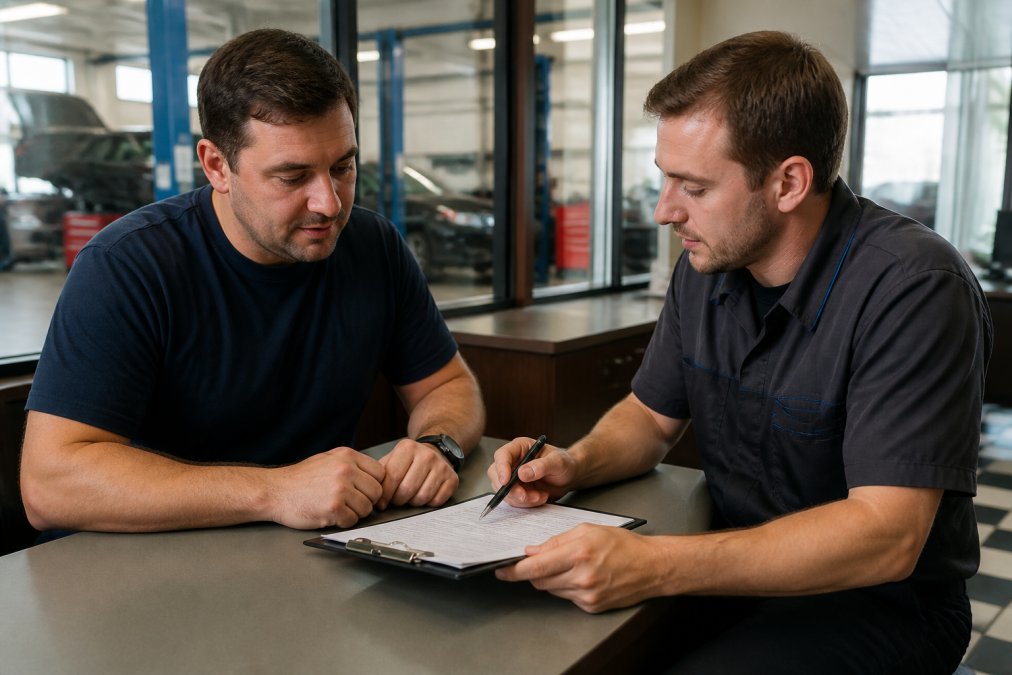
The right questions to ask a mechanic before repair fall into two categories: what you ask on the phone and what you ask in person. The phone call screens the shop before you waste a trip. The in-person conversation confirms whether the written estimate, warranty terms, and parts sourcing match what you were told.
Phone Inquiry Questions That Save You Time and Money
Start with these when you call:
- Do you charge a diagnostic fee, and does it apply toward the repair if I approve the work?
- Can you give me a written estimate before any work begins?
- Do you offer a warranty on parts and labor, and how long does it last?
- How long is your current turnaround time for this type of repair?
- Do you have loaner cars or a shuttle if my car stays overnight?
A service advisor who answers these without hesitation runs a transparent operation; one who dodges the warranty question is telling you something.
In-Person Questions About Estimates, Warranty, and Parts
Once you're at the shop, ask whether the estimate covers parts and labor separately, whether the shop uses OEM or aftermarket parts, and who authorizes additional work found mid-repair. Get the answer in writing on the repair order, that's your protection if the final bill doesn't match the quote.
Step 4: Spot Auto Repair Shop Red Flags Before You Commit
Most red-flag lists stop at "the shop was pushy." What you want is observable behaviors that predict a bad outcome before money changes hands, and a few are grounded in federal law, not just vibes.
Behavioral Red Flags You Can Verify in the First Ten Minutes
- Refusal to put the estimate in writing. Under most state repair statutes, you are entitled to a written estimate before work begins. A shop that won't commit to one in writing is the single strongest predictor of a billing dispute.
- Blanket "you need everything" recommendations with no measurements. A real diagnosis comes with numbers: brake pad thickness in millimeters, battery cold-cranking amps versus spec, tire tread in 32nds of an inch. No measurement means they're guessing.
- No authorization process for additional work. Ask: "If you find something else mid-repair, who calls me, and do you stop until I approve?" A shop that keeps working and bills later has no authorization discipline.
- Cash-only or no itemized invoice. Itemized parts and labor lines are standard practice; refusing to provide them makes it impossible to compare or dispute charges.
- Warranty answers that shift. Ask the same warranty question twice, once on the phone, once at the counter. If the terms change, the warranty isn't real.
- No physical address tied to the business license. Verify the shop's name and address against your state's licensing or registration database before you drop the car off.
The Legal Red Flag Most Drivers Don't Know About
Under the Magnuson-Moss Warranty Act, a manufacturer cannot void your new-car warranty simply because an independent shop performed routine maintenance or repairs, as long as the work was done correctly and the parts meet the manufacturer's specifications. If a dealership service writer says using an outside mechanic "voids your warranty," that statement is generally not accurate.
What a Clean, Organized Shop Actually Looks Like
Shop cleanliness tells you how the team treats its own equipment, which usually predicts how it treats your car. Walk through the bays if you're allowed, a shop that hides its work area usually has a reason. Look for:
- Floors free of pooled fluids and scattered tools
- Parts stored on shelves, not piled in corners
- Technicians wearing safety gear (eye protection, gloves, closed-toe boots)
- Diagnostic equipment that looks maintained, not dusty
- A waiting area that's clean and staffed
- Torque wrenches and specialty tools visible, not improvised
- Vehicles in the lot with repair orders on the dash, not abandoned for weeks
Step 5: Understand Labor Rates, Diagnostic Fees, and Billing Practices
Labor rates and diagnostic fees vary by region, shop size, and vehicle complexity, so there's no single fair number. What matters is that the shop discloses its labor rate upfront, explains how it bills (by the hour or by the job), and puts the diagnostic fee policy in writing. Ask whether the rate changes for specialized work like hybrid diagnostics or European makes.
Why the Cheapest Hourly Rate Isn't Always the Best Deal
A low labor rate can hide padded hours, unnecessary parts, or a technician who lacks the proficiency to fix the problem the first time. A shop that charges more per hour but diagnoses accurately and stands behind the repair usually costs less overall. Compare the total written estimate, not the hourly number.
Step 6: Test the Shop With a Small Repair First
Test a new shop with a small, inexpensive job before trusting it with a major repair. Book an oil change, tire rotation, or state inspection, and watch how the shop handles scheduling, communication, and the final bill. If the price matches the estimate, you've found a facility worth keeping.
Step 7: Confirm Warranty Coverage, Turnaround Time, and Payment Options
Warranty coverage, turnaround time, and payment options decide whether a shop fits your life. Here's how to evaluate each one, plus the insurance-repair scenario most guides skip.
How to Read a Repair Warranty Like a Contract
A repair warranty has four variables, and a shop that answers only one is hiding the rest:
- What's covered. Parts only? Labor only? Both? A "parts warranty" that excludes labor means you pay the shop's hourly rate again if the part fails.
- How long it lasts. Terms range from 12 months / 12,000 miles to nationwide lifetime warranties on certain parts at larger chains. Ask for the number in months and miles, not "a year or so."
- Where it's honored. A warranty that only works at the original location is worth far less than one honored at any affiliated shop. If you commute or travel, this matters.
- What voids it. Missed maintenance intervals, DIY work on the same system, or off-road use can void coverage. Get the exclusions in writing.
Turnaround Time: Ask Three Questions, Not One
"How long will it take?" invites a guess. Instead ask:
- When will the vehicle be on a lift? This tells you whether the shop is scheduling realistically or just booking you in.
- What's the parts lead time? For older or less common vehicles, a part can take days to arrive, not the shop's fault, but you need to know.
- What happens if the job runs long? Confirm shuttle service, loaner availability, or a rideshare credit before you drop the keys.
Payment and Financing Before the Bill Arrives
For repairs over a few hundred dollars, ask about financing before you're at the counter. Many independent shops partner with automotive financing programs that offer promotional periods with no interest if paid in full. Read the terms: deferred-interest promotions can retroactively charge interest from day one if you miss the payoff window.
The Gap Most Guides Skip: Choosing a Shop for Insurance-Covered Repairs
If your repair is paid by an insurance claim, collision, comprehensive, or third-party liability, the shop-selection rules change:
- You generally have the right to choose your own repair shop. Insurers may recommend a network shop, but in most states they cannot require you to use one. Confirm the specifics of your policy and your state's insurance regulations.
- The insurer pays the shop directly, not you. That means the shop needs to be willing to work with insurance adjusters, supplement requests, and photo documentation. Ask upfront: "Do you work with insurance claims, and do you handle supplements if hidden damage is found?"
- Get the estimate and the insurer's approval in writing before work starts. If the shop begins repairs before the adjuster signs off, you can be stuck in the middle of a dispute.
- Ask about the warranty on insurance repairs. It should match the shop's standard warranty, don't accept a shorter term just because a third party is paying.
Conclusion
Finding a mechanic you trust takes a little upfront work, but it saves you from repeat visits, padded bills, and repairs that don't hold. Kerner's Auto has served drivers since 1973 with ASE-certified technicians, a state-of-the-art facility, and a commitment to honest diagnostics. We offer complimentary shuttle service and loaner cars, flexible financing through Synchrony Car Care for larger repairs, and a comfortable waiting area with free Wi-Fi and a complimentary car wash. Make an appointment with Kerner's Auto and get a written estimate, a clear explanation, and work backed by a team that's been earning trust for over fifty years.
Frequently Asked Questions
What certifications should a good mechanic have?
Look for ASE certification, which tests technicians in specific areas like brakes, engines, and electrical systems. Many shops also require state licensing. For hybrid or EV work, ask about manufacturer-specific training. Kerner's Auto employs ASE-certified technicians, and the shop has been state licensed since 1973. Certification alone doesn't guarantee quality, but it shows a baseline of technical proficiency and a commitment to ongoing education.
How do I spot a bad mechanic before I agree to repairs?
Watch for these auto repair shop red flags: refusing to provide a written estimate, pressure to approve work immediately, no physical address or vague answers about warranty coverage, a dirty or disorganized facility, and technicians who won't explain the repair in plain language. A trustworthy shop will put everything in writing, show you the failed part if you ask, and never rush your decision. If something feels off during a phone inquiry or in-person visit, trust that instinct and get a second opinion.
Should I go to a dealership or an independent shop?
Dealerships often have brand-specific training and equipment, but independent shops can be just as capable, especially if they hold ASE certification and invest in advanced diagnostic tools. For routine maintenance and most repairs, a well-reviewed independent shop frequently offers lower labor rates and more flexible scheduling. For complex warranty work or software updates on a newer vehicle, a dealership may be necessary. The best choice depends on your vehicle's needs, your budget, and the shop's reputation.
What questions should I ask a mechanic before agreeing to a repair?
Ask for a written estimate that breaks down parts and labor separately. Inquire whether the shop uses OEM or aftermarket parts and how that affects warranty coverage. Confirm the diagnostic fee and whether it's applied to the repair cost. Ask about turnaround time and whether loaner cars or shuttle service is available. Finally, request a digital vehicle inspection report if the shop offers one. These questions to ask a mechanic before repair protect you from surprise charges and help you compare shops fairly.
Have a question about your vehicle or want a second opinion on a repair estimate? Kerner's Auto is here to help.