 how-to
How to Identify Honest Auto Repair Shops: 2026 Guide
Table of Contents
- Step 1: Screen Shops Before You Ever Call
- Step 2: Questions to Ask a Mechanic Before Repair
- Step 3: Signs of a Dishonest Mechanic to Watch For
- Step 4: How to Verify ASE Certification and Credentials
- Step 5: Audit the Shop Visit and Use the Second Opinion Protocol
- Frequently Asked Questions
Last Updated: September 28, 2026
Step 1: Screen Shops Before You Ever Call
Learning how to identify honest auto repair shops starts long before you hand over your keys. It starts with 20 minutes of research at your kitchen table.
The screening process is simple, and it filters out most problems before they begin.
Start with these steps:
- Check Google and Yelp ratings, but read the 2- and 3-star reviews first
- Look for shops that respond to negative feedback with specifics
- Confirm the shop lists its address, license, and staff credentials
- Search for complaints with your state's consumer protection office
The middle reviews tell the real story.
Reading Online Reviews Like an Investigator
Reviews are data, not decoration. Read them the way an insurance adjuster reads a claim.
Look for patterns, not one-off gripes:
- Do multiple reviewers mention surprise charges?
- Does the shop explain repairs in plain language?
- Are there repeat mentions of the same technician by name?
Manufacturer-Specific vs. Independent Shops: Which Fits Your Car?
The right shop depends on your car, not on brand loyalty. A dealership has factory tools and software for its own brand. An independent shop often covers more makes and can offer more flexible scheduling.
Here's the honest trade-off:
| Shop Type | Best For | Watch For |
|---|---|---|
| Dealership | New cars under warranty, recalls | Higher labor rate, longer waits |
| Manufacturer-specific independent | One brand, out of warranty | Limited makes serviced |
| General independent shop | Most makes, routine maintenance | Confirm diagnostic tools match your car |
Step 2: Questions to Ask a Mechanic Before Repair
The best questions to ask a mechanic before repair are the ones that force specifics. Vague answers are your first warning sign.
Ask these before you agree to any work:
- "Can I get a written estimate before you start?"
- "What's your diagnostic fee, and does it apply to the repair?"
- "Will you call me before doing anything beyond the estimate?"
- "Are these parts original equipment manufacturer or aftermarket?"
- "What's your labor rate, and how do you bill time?"
- "What warranty coverage comes with this repair?"
Step 3: Signs of a Dishonest Mechanic to Watch For
Recognizing the signs of a dishonest mechanic protects your wallet more than any loyalty program. Most problems show up in communication and paperwork, not in the engine bay. The tell is rarely a single dramatic moment; it is a pattern of vagueness that repeats across the estimate, the authorization, and the final invoice.
Watch for these behaviors:
- Pressure to approve work "today only" or before you have read the estimate
- Refusal to show you the failed part, or a promise to "show you later" that never happens
- No written estimate or signed repair authorization before work begins
- Recommendations that don't match your service history or your mileage
- A final bill that exceeds the estimate without a phone call for approval
- A technician who cannot explain, in plain language, what failed and why
- A shop that discourages a second opinion or acts offended when you ask
Red Flags in Invoices and Repair Orders
Your invoice is a paper trail, and it should read like one. A clean repair order lists parts, labor, and the reason for each line. This is where the documentation-audit angle separates a careful consumer from a lucky one, most guides tell you to "check the invoice," but few explain what padding actually looks like on the page.
Check for these invoice problems:
- Vague line items. "Shop supplies," "miscellaneous," or "misc. labor" with a large charge and no explanation. A small shop-supplies fee is common and often capped; a large one is a place padding hides.
- Labor hours that don't match the job. Ask what the labor time is for the repair. If the invoice shows more hours than the job should take, ask why.
- No part numbers or brand names. A line that says only "brake pads" tells you nothing about quality or price tier. Ask for the part number and whether it is OEM, OE-equivalent, or economy aftermarket.
- Charges for work you never authorized. Compare the invoice line by line against the written estimate and any phone approvals you gave.
- Duplicate or bundled fees. Environmental fees, disposal fees, and "diagnostic" charges that reappear after you already paid a diagnostic fee.
- A total that moved without a call. Any change beyond the estimate should have triggered a phone call and a new authorization.
The Second Opinion Protocol
Asking for a second opinion is the single most effective audit you can run, and it does not require confrontation. The trick is to frame it as a decision you are making, not a verdict on the technician.
A simple script works:
- "Thanks for the estimate. I'd like to get a second opinion before I commit, can you email me the written estimate and the diagnostic report?"
- Take the written estimate and any diagnostic printout to one other shop. Do not lead with the first shop's conclusion; ask them to diagnose independently.
- Compare not just the price but the diagnosis. If both shops name the same failed component and the same repair, you have confirmation. If they diverge, ask each to explain the evidence.
- Return to the first shop with your decision. Honest shops expect this and do not take offense.
Step 4: How to Verify ASE Certification and Credentials
You can learn how to verify ASE certification in about five minutes, and it's worth every minute. ASE stands for the National Institute for Automotive Service Excellence, the industry's main testing and certification body (About ASE).
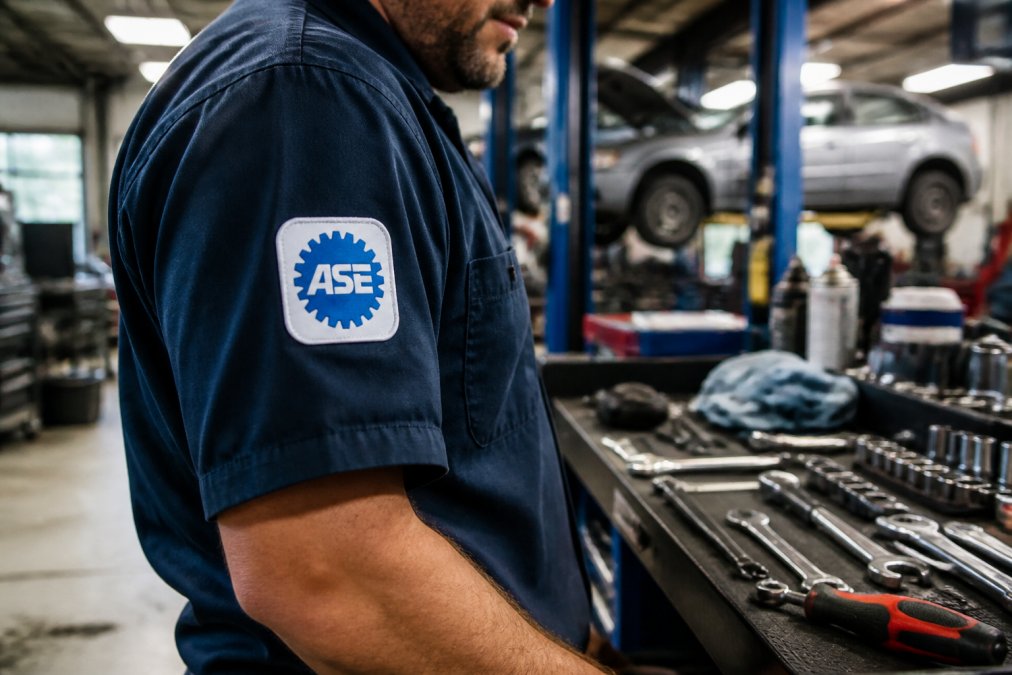
Here's how to check credentials:
- Ask to see the technician's ASE card or certificate
- Look for the blue and white ASE seal posted in the shop
- Confirm the shop holds a current state license
- Ask whether technicians hold manufacturer-specific training
Step 5: Audit the Shop Visit and Use the Second Opinion Protocol
A shop visit is an audit, and you're the auditor. Pay attention from the parking lot to the final invoice. Most guides stop at "is the waiting room clean?", the more useful audit is whether the shop documents what it finds and shares that documentation with you.
Use what you observe:
- Is the waiting area clean and organized, and are the bays tidy?
- Do technicians use diagnostic scan tools, or guess by ear?
- Does the service advisor write down your complaint in your words, or rewrite it into a repair they want to sell?
- Do they offer a vehicle inspection report with photos?
- Do they hand you the old parts without being asked?
What Shop Cleanliness and Digital Diagnostics Reveal
Shop cleanliness signals how a team treats everything else. A tidy bay usually means torque specs get followed and parts get labeled. It is a proxy, not proof, but it is a useful one.
- Trouble codes (DTCs). A code like P0301 points to a cylinder misfire, but the code alone does not name the failed part. A shop that treats the code as the diagnosis is skipping the step that separates a guess from a repair.
- Live data and freeze-frame data. Good diagnostics include the sensor readings captured when the fault occurred. This is the evidence behind the recommendation.
- A written diagnostic narrative. The best shops write a short explanation: what was tested, what was found, what it means, and what happens if you wait.
The Second Opinion Protocol
For any repair over a few hundred dollars, run the Second Opinion Protocol. Take the written estimate and the diagnostic report to one other shop and ask for their independent read. Honest shops expect this and don't take offense.
A simple script keeps it polite:
- "Thanks for the estimate. I'd like to get a second opinion before I commit, can you email me the written estimate and the diagnostic report?"
- At the second shop, do not lead with the first shop's conclusion. Ask them to diagnose independently and write down what they find.
- Compare the diagnosis, not just the price. Same failed component and same repair from two independent shops is strong confirmation. Divergence means you should ask each to walk you through the evidence.
- Return to the first shop with your decision. You are not accusing anyone; you are doing your homework.
Frequently Asked Questions
How do I know if a mechanic is honest?
An honest mechanic provides a written estimate before starting work, explains repairs in plain language, and shows you the failed part. Ask about their diagnostic fee and labor rate upfront. They should welcome questions and never pressure you into same-day repairs. Verify their ASE certification and check online reviews for patterns of unnecessary upselling.
What are the red flags of an untrustworthy auto repair shop?
Watch for refusal to provide a written estimate, vague explanations of what's wrong, pressure to approve repairs immediately, and invoices with unclear parts markup or unexplained diagnostic fees. Other signs include not offering to return old parts, no visible technician certification, and a dirty, disorganized service facility. Trust your gut if something feels off.
Should I ask for my old car parts back after a repair?
Yes. Asking for old parts is one of the best ways to confirm the repair was actually performed. A trustworthy shop will gladly return replaced components. If a shop refuses or claims they were already discarded, that's a warning sign. You can also ask to see the failed part before they begin the repair.
What certifications should I look for in a reputable mechanic?
Look for ASE certification, which requires passing standardized exams and meeting experience requirements. You can verify a technician's credentials through the ASE website. Also check for state licensing where applicable. Shops with multiple certified technicians and ongoing training demonstrate a commitment to accountability and technical expertise.