 how-to
Hybrid Vehicle Repair Shop Requirements: A 2026 Guide
Table of Contents
- What It Takes to Run a Hybrid Vehicle Repair Shop
- High Voltage Safety Training for Auto Mechanics
- ASE L3 Certification Requirements for Hybrid Technicians
- Hybrid Vehicle Diagnostic Tools and Equipment
- Facility Infrastructure and Shop Insurance Requirements
- How Hybrid Service Differs from Internal Combustion Engine Work
- ROI and Business Model for Adding Hybrid Service
- Conclusion: Building a Hybrid-Ready Shop
- Frequently Asked Questions
Last Updated: October 2, 2026
What It Takes to Run a Hybrid Vehicle Repair Shop
Meeting hybrid vehicle repair shop requirements takes more than a standard lift and a code reader. It takes high-voltage safety training, the right diagnostic tools, dedicated facility space, and certifications proving your techs can work safely around live battery systems.
The core tension most shop owners miss: hybrid work isn't a harder version of gas-engine repair. It's a different discipline with its own safety rules, tools, and liability exposure.
High Voltage Safety Training for Auto Mechanics
High-voltage safety training teaches techs to isolate, test, and work around battery systems carrying hundreds of volts. It's the first requirement, not an optional add-on.
Every technician who touches a hybrid needs training in voltage isolation, disconnect procedures, and safe voltage measurement. Core skills include:
- Lockout and tagout of the high-voltage system before any repair
- Using a digital multimeter rated for the system's voltage
- Verifying zero voltage before disconnecting any orange cable
- Understanding inverter/converter and electric motor hazards
- Recognizing thermal runaway warning signs in lithium-ion battery packs
A common mistake is treating this as a one-time class. Battery tech changes fast, and refresher training keeps techs current on new pack designs and safety standards.
Personal Protective Equipment and Shop Safety Standards
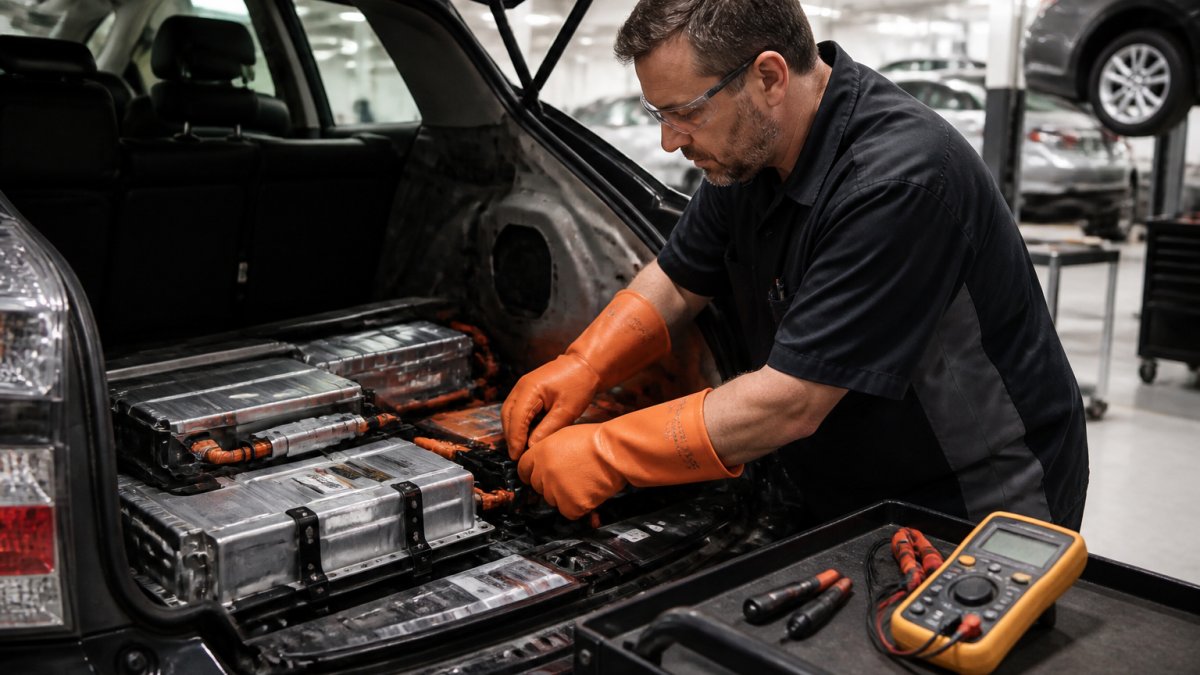
Personal protective equipment is non-negotiable around high-voltage systems. At minimum, techs need dielectric gloves rated for the voltage they're working near, plus safety glasses and insulated tools.
Shop safety standards also cover the space itself. You need clear high-voltage isolation zones, insulated matting, and a documented lockout procedure. The OSHA electrical safety standards set the baseline for workplace electrical safety that hybrid shops must follow.
ASE L3 Certification Requirements for Hybrid Technicians
ASE L3 certification is the light duty hybrid/electric vehicle specialist credential proving a technician can safely service hybrid and electric drivetrains. It's the clearest signal to customers that your shop is qualified.
The L3 test covers high-voltage safety, battery systems, regenerative braking, and powertrain diagnostics. To earn it, a tech typically needs prior ASE certification and hands-on experience. The ASE certification program details outline the exact prerequisites and test content.
For a shop owner, certification proves technical proficiency and supports insurance and liability positions if something goes wrong.
| Requirement | What It Covers | Who Needs It |
|---|---|---|
| High-voltage safety training | Isolation, PPE, zero-voltage checks | Every hybrid tech |
| ASE L3 certification | Battery, motor, regenerative braking | Lead hybrid techs |
| Insulated tool set | Voltage-rated hand tools | Every hybrid tech |
| Documented lockout procedure | Shop-wide safety standard | Whole shop |
Hybrid Vehicle Diagnostic Tools and Equipment
Hybrid vehicle diagnostic tools go beyond a standard scan tool. You need equipment that reads battery state of health, module temperatures, and inverter data.
The essentials include:
- A diagnostic scan tool with hybrid-specific software
- Insulation testing equipment for high-voltage cables
- A battery state of health (SOH) tester
- Thermal imaging for battery cooling systems
- A voltage-rated multimeter and amp clamp
A common mistake is buying a general scan tool and assuming it covers hybrids. Hybrid powertrain diagnostics need manufacturer-level access to battery and motor modules.
Energy Department guidance on electric vehicle technology explains how these systems work and why specialized tools matter.
Battery Health Testing and Thermal Management Checks
Battery state of health testing measures how much capacity a pack has left and flags failing cells. Thermal management checks confirm the battery cooling system is doing its job.
Both are routine parts of hybrid preventative maintenance. Skipping them leads to surprise failures, so build these checks into every hybrid service interval.
Facility Infrastructure and Shop Insurance Requirements
Facility infrastructure for hybrid work means dedicated space, proper ventilation, and safe battery storage. Shop insurance must also reflect the added risk of high-voltage work, the build-out and the coverage behind it keep a shop legal, insurable, and protected when a pack fails.
What the Facility Actually Needs
A hybrid-ready bay is not a standard service bay with a sign on it. The physical requirements break down into four areas:
- High-voltage isolation zone. A marked, dedicated area where only trained techs work on live or partially discharged systems, separated from general traffic. Clear floor marking and signage are the baseline.
- Insulated flooring or matting. Dielectric matting rated for the voltages present, kept clean and dry. Cracked, oil-soaked, or worn matting loses its dielectric properties and must be replaced.
- Ventilation. Lithium-ion packs can off-gas if a cell vents. The work area needs airflow that moves vapors away from techs and out of the building, not a recirculating shop fan.
- Fire suppression rated for lithium-ion. A standard Class A/B/C extinguisher is not the right tool for a lithium-ion battery fire. Lithium fires can reignite after the visible flame is out, so many shops add a lithium-rated extinguishing agent and a documented response procedure.
- Battery quarantine area. A separated spot, ideally away from the main building or in a fire-rated enclosure, for damaged, swollen, or suspect packs awaiting diagnosis or disposal. A swollen pack is a stored energy hazard, not scrap.
- PPE storage. Dielectric gloves, face shields, and insulated tools need a clean, dry, dedicated storage location. Gloves stored in a toolbox or exposed to ozone, sunlight, or chemicals degrade and fail inspection.
The Insurance Side Most Owners Miss
Most standard garage liability policies were written for gas-engine work. They do not automatically cover high-voltage battery handling, lithium-ion fire loss, or technician injury from a live pack. Before you take on hybrid jobs, talk to your insurer about:
- A high-voltage endorsement or rider that explicitly extends coverage to battery service and storage.
- Garagekeepers coverage that accounts for customer vehicles with high-voltage packs stored on your lot overnight.
- Pollution or environmental liability for battery disposal and any electrolyte or coolant release.
- Workers' compensation classification, high-voltage work can change how your techs are classified and rated.
A common pattern is a shop that trains a tech, buys the tools, takes in a hybrid job, and then discovers after a battery fire that the loss is excluded. The fix is a conversation with the insurer before the first hybrid rolls in, not after.
Codes and Standards to Check
The OSHA electrical safety standards set the workplace baseline for electrical safety and lockout/tagout. Local fire codes govern battery storage and fire suppression requirements, and those vary by jurisdiction, so confirm the specifics with your local authority having jurisdiction before you build out a bay. The National Fire Protection Association publishes standards that many jurisdictions adopt for battery storage and fire protection.
A Practical Build-Out Order
If you are adding hybrid capability to an existing shop, a workable sequence is:
- Confirm insurance coverage and any required endorsements first, before you spend on equipment.
- Designate and mark the isolation zone and quarantine area.
- Add ventilation and the correct fire suppression for the space.
- Buy and store PPE and insulated tools properly.
- Document the lockout procedure and post it in the bay.
Doing insurance and facility work before the first hybrid job is cheaper than retrofitting after an incident, and it shows customers and insurers a shop that planned for the risk instead of reacting to it.
How Hybrid Service Differs from Internal Combustion Engine Work
Hybrid service differs from internal combustion engine (ICE) work in three big ways: safety, diagnostics, and parts.
First, safety. ICE work rarely involves live high-voltage circuits. Hybrid work always does.
Second, diagnostics. A hybrid ties the engine, electric motor, inverter/converter, and battery into one system.
Third, wear patterns. Regenerative braking means brake pads last longer, but the battery and cooling systems need more attention.
| Area | ICE Vehicle | Hybrid Vehicle |
|---|---|---|
| Primary safety risk | Moving parts, fuel | High-voltage systems |
| Key diagnostic tool | Standard scan tool | Hybrid-capable scan tool |
| Brake wear | Frequent pad changes | Longer pad life, regen braking |
| Battery service | 12V only | High-voltage pack + 12V |
| Tech certification | Standard ASE | ASE L3 specialist |
ROI and Business Model for Adding Hybrid Service
Adding hybrid service is a business decision, not just a technical one. The payoff comes from capturing customers other shops turn away, but the investment is real, and timing matters. Here's a framework for deciding whether and when the math works.
The Cost Side
The investment breaks into four buckets:
- Training. High-voltage safety training and ASE L3 preparation for at least one lead tech, plus refresher training as battery designs change. Budget for the tech's time off the floor as well as the course cost.
- Tools and equipment. A hybrid-capable scan tool with manufacturer-level module access, insulation testing equipment, a battery state-of-health tester, thermal imaging, and voltage-rated hand tools. This is the largest single line item for most shops.
- Facility. Isolation zone marking, dielectric matting, ventilation, lithium-rated fire suppression, PPE storage, and a quarantine area. Some is one-time; some is ongoing maintenance.
- Insurance and compliance. The endorsement or rider, plus any change in workers' comp classification.
The Revenue Side
Hybrid work carries higher diagnostic time than comparable gas-engine jobs because the systems are more integrated and safety steps add time. A hybrid diagnostic can justify a higher labor rate, but only if you quote it that way. Shops that price hybrid work like ICE work leave money on the table and underfund the training and tools that make the work safe.
Beyond diagnostics, recurring revenue comes from:
- Battery state-of-health testing built into every hybrid service interval.
- Thermal management and cooling system service.
- Regenerative braking system inspection (pads last longer, but the system still needs attention).
- Inverter and converter service.
A Simple Payback Framework
You do not need a complex model. Work through four questions:
- How many hybrids are already in your service area? If you are turning away hybrid jobs today, you have a baseline. If you rarely see them, the volume may not be there yet.
- What is the fully loaded cost of the first certified tech and the core tool set? Include training time, tools, and the insurance change.
- What is the realistic monthly hybrid job count once you are certified and listed? Be conservative, reputation takes time to build.
- How many months of hybrid gross profit does it take to recover the investment? If the answer is longer than you are comfortable with, start with training and tools only and defer the full facility build-out.
A common pattern is to start with one certified tech and a shared hybrid bay, then add a second bay and tech once hybrid jobs consistently fill the first. The risk is overinvesting in a dedicated bay and full tool set before you have the volume to keep them busy.
Pricing and Positioning
Hybrid customers are often price-sensitive because they bought the car partly for fuel savings, but they are also safety-sensitive, they want a shop that knows what it is doing around a high-voltage pack. Certification, visible safety practices, and clear communication about battery health build trust faster than discounting. Position on competence, not on being the cheapest hybrid shop in town.
When the Math Does Not Work Yet
If your area does not yet have enough hybrid volume to justify the full investment, you still have options. Train one tech and buy the core safety and diagnostic tools without building a dedicated bay, then scale the facility as volume grows. You can also partner with a hybrid-specialist shop for jobs you cannot safely handle, rather than turning customers away.
Conclusion: Building a Hybrid-Ready Shop
The core hybrid vehicle repair shop requirements come down to four things: trained techs, the right tools, a safe facility, and proper insurance. Miss any one and the risk outweighs the reward.
Kerner's Auto is backed by ASE-certified technicians and a state-of-the-art facility with nine bays. We offer complimentary shuttle service, loaner cars, and flexible financing through Synchrony Car Care to keep you moving while we work.
Frequently Asked Questions
Can a normal mechanic service a hybrid car?
A mechanic without hybrid-specific training can handle basic tasks like tire rotations, brake inspections, and oil changes on a hybrid. However, any work involving high-voltage systems, the lithium-ion battery, inverter/converter, or regenerative braking requires specialized training and equipment. High-voltage systems can carry 200 to 650 volts, which is lethal without proper voltage isolation procedures and personal protective equipment. Shops that lack this training should not attempt hybrid drivetrain repairs.
What specific safety equipment is required for hybrid vehicle repair?
Technicians need Class 0 or Class 00 rated dielectric gloves, insulated tools rated for 1,000 volts, a high-voltage disconnect procedure checklist, and a CAT III or CAT IV rated multimeter for voltage measurement. OSHA compliance also requires an arc flash risk assessment and lockout/tagout procedures for the high-voltage disconnect. Shops must maintain insulation testing equipment to verify glove integrity before each use.
How do I know if a repair shop is qualified to work on hybrid vehicles?
Look for ASE L3 certification (Light Duty Hybrid/Electric Vehicle Specialist), which confirms a technician passed a dedicated hybrid exam covering high-voltage safety protocols, battery state of health (SOH) testing, and powertrain diagnostics. Ask whether the shop has a dedicated high-voltage bay, PPE on site, and diagnostic scan tools capable of reading hybrid-specific codes. A shop that hesitates on these questions likely lacks the infrastructure to service hybrid vehicles safely.
Do hybrid vehicles require more frequent maintenance than gas cars?
Hybrids generally require less frequent brake service because regenerative braking reduces pad wear, but they add new maintenance items: battery cooling systems need inspection, thermal management fluids should be checked at service intervals, and the electric motor and inverter/converter require periodic diagnostics. Preventative maintenance on a hybrid still follows the manufacturer's schedule, but the tasks differ from those on an internal combustion engine (ICE) vehicle.