 ultimate-guide
Pre Purchase Inspection Checklist 2026: Used Car Guide
Table of Contents
- What to Look for When Buying a Used Car Checklist
- Under-the-Hood Inspection: Engine, Fluids, and Drivetrain
- How to Read a Vehicle History Report
- Used Car Test Drive Checklist
- Digital Diagnostics and EV Inspection Points
- Used Car Inspection Cost 2026: What You're Paying For
- Using Your Pre Purchase Inspection Report to Negotiate
- Conclusion
- Frequently Asked Questions
Last Updated: October 2, 2026
What to Look for When Buying a Used Car Checklist
A pre purchase inspection checklist is a structured, bumper-to-bumper evaluation of a used vehicle before money changes hands, covering exterior condition, interior wear, mechanical health, and digital diagnostic data. At Kerner's Auto, our ASE-certified technicians are committed to thorough evaluations, and the difference between a thorough inspection and a quick walkaround often decides whether a buyer drives home satisfied or inherits someone else's problem.
Exterior, Tires, and Rust
Start outside, in daylight, with the vehicle clean and dry. Rain hides scratches, dents, and fresh paintwork.
Interior, Electronics, and Odometer
Sit in every seat, not just the driver's. Upholstery wear should roughly match the mileage shown. A pedal pad worn through at 40,000 miles, or a driver's seat bolster flattened far beyond the rest of the cabin, hints at an odometer discrepancy.
Test every electronic function with the engine running:
- Power windows, locks, and mirrors
- Heating, air conditioning, and defrost
- Infotainment, backup camera, and all USB ports
- Headlights, turn signals, brake lights, and hazard flashers
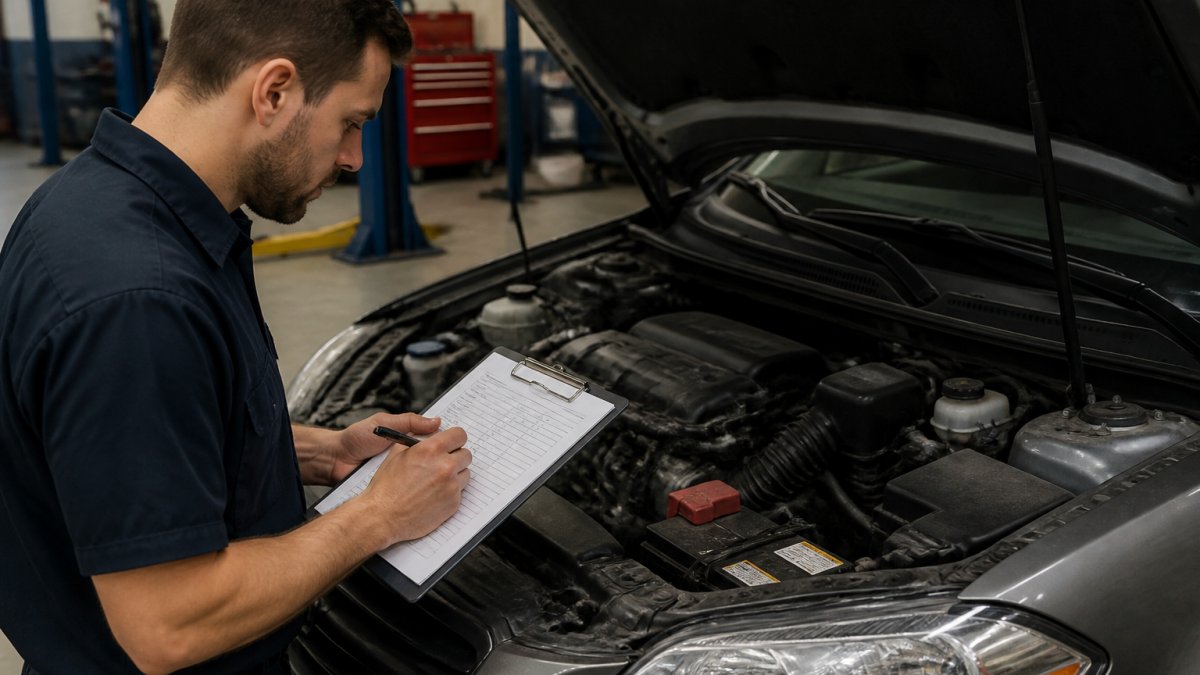
Under-the-Hood Inspection: Engine, Fluids, and Drivetrain
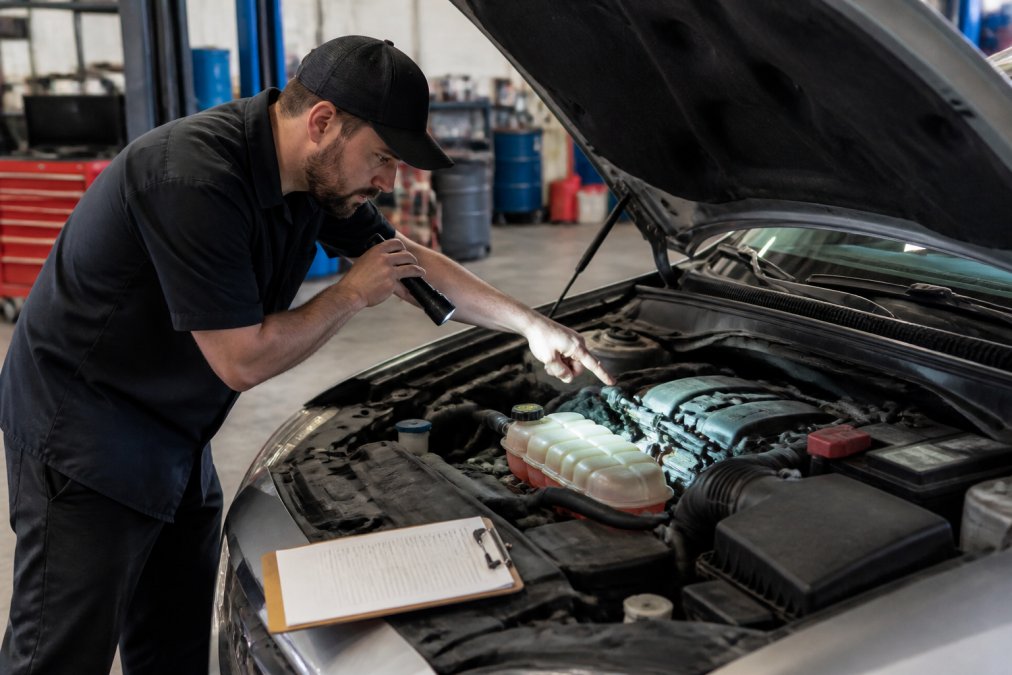
Pop the hood only after the engine has cooled, and bring a flashlight. The engine bay tells you more about maintenance habits than any service record.
Brakes, Suspension, and Undercarriage
Brake pad wear is measurable: less than 3mm of pad material remaining means replacement is due soon. Run a fingernail across the rotor; deep grooves or a pronounced lip at the edge mean the rotors need machining or replacement.
How to Read a Vehicle History Report
A vehicle history report compiles title transfers, accident history, service visits, and odometer readings from state databases and insurance claims. It is a screening tool, not a guarantee.
Order the report using the vehicle identification number, not the license plate. Then read it in this order:
- Title status, a branded title (salvage, rebuilt, flood, lemon) permanently reduces value and insurability.
- Accident history, a minor fender bender is fine; structural damage is not.
- Odometer readings, look for gaps or decreases between entries.
- Service history, regular oil changes and scheduled maintenance suggest a careful owner.
Used Car Test Drive Checklist
A proper road test lasts at least 20 minutes and includes city streets, highway speeds, and a few hard stops in a safe, empty area.
Test the following on every drive:
- Cold start behavior (arrive with the engine cold)
- Braking under firm pressure, checking for pulling or pulsation
- Acceleration from a rolling stop
- Reverse gear engagement
- Cruise control and any driver-assist features
Digital Diagnostics and EV Inspection Points
A flashlight and a magnet will not tell you whether someone cleared a check-engine light the morning of your visit. That is what a scan tool is for, and in 2026 it is the highest-value step a used-car buyer can add to a visual checklist.
Using an OBD-II Scanner the Right Way
Every vehicle sold in the United States since 1996 has a standardized OBD-II port, usually under the driver's side dash within a foot of the steering column. A basic Bluetooth or handheld scanner that reads generic powertrain codes costs well under $100 at most auto parts stores, and many retailers loan one with a deposit.
- Stored codes, hard faults the computer has already logged. Write down every code number, not just the description.
- Pending codes, faults the computer has seen once but not yet confirmed. These are the codes a seller is most likely to have missed, and they often precede a stored code by a few drive cycles.
- Permanent codes, emissions-related faults that cannot be cleared by disconnecting the battery or using a consumer scan tool. If a permanent code is present, the vehicle has a real, unresolved emissions problem.
- Readiness monitors, the computer's self-tests for catalyst, oxygen sensor, EVAP, and misfire systems. If monitors show "not ready" on a vehicle that has clearly been driven recently, someone likely cleared the codes to hide a fault. A seller who says "the light just went off on its own" is describing the same pattern.
EV and Hybrid Inspection Points
EV and hybrid inspections replace several gas-engine checks with battery and high-voltage system checks that most printed checklists still omit.
- Battery state of health (SOH), ask the seller or dealer for a battery health report, which most manufacturers can generate from the vehicle's telematics. SOH is expressed as a percentage of original capacity; a car with 85% SOH at 60,000 miles is normal, while 70% at 30,000 miles suggests abuse or a defective pack.
- Charging port and cable, inspect the port for bent pins, scorching, or moisture intrusion, and confirm the latch on the charge cable clicks and releases cleanly. Test both AC Level 2 and DC fast charging if the seller will allow it.
- Regenerative braking feel, during the test drive, lift off the accelerator and confirm the regen braking engages smoothly. A sudden loss of regen or a warning light often points to a battery management or inverter issue.
- High-voltage cable routing, look for chafed orange cables, unauthorized splices, or aftermarket wiring, which can void warranties and create a serious safety hazard.
- Thermal management, ask whether the battery has a liquid-cooled or air-cooled pack, and whether the coolant has ever been serviced. Liquid-cooled packs generally hold up better in extreme climates but add a maintenance item.
Reading the Data, Not Just the Codes
A scan tool also shows live data: fuel trims, coolant temperature, battery voltage, and transmission temperature. Long-term fuel trims beyond roughly plus or minus 10% suggest a vacuum leak, a failing mass airflow sensor, or a fuel delivery problem, while a coolant temperature that never reaches normal operating range during a 20-minute drive often means a stuck-open thermostat.
Used Car Inspection Cost 2026: What You're Paying For
Used car inspection cost varies by shop, vehicle type, and depth. A basic safety check costs less than a comprehensive pre-purchase inspection that includes a diagnostic scan, compression test, and full undercarriage review.
Using Your Pre Purchase Inspection Report to Negotiate
A written mechanic report is the single most useful negotiation tool a used car buyer can hold, because it converts opinions into documented facts. The seller can argue with your feelings about the car, but not with a shop invoice listing a leaking water pump, worn front pads at 2mm, and a P0420 code.
Before the Conversation
Do three things before you say a word about price:
- Get the repair estimate in writing. Ask the inspecting shop to itemize each finding with a parts-and-labor estimate, not a lump sum. A report that says "$1,400 in needed work" is weaker than one that says "front pads and rotors, $520; water pump and coolant, $880."
- Separate safety items from maintenance items. Worn brakes, bald tires, and a cracked brake line are safety issues that justify a firm ask. A due-for-replacement cabin filter is a negotiating chip, not a deal-breaker.
- Set your walk-away number in advance. Decide before the conversation what total repair cost makes the deal not worth it to you. Write it down. Sellers are skilled at moving that number in the moment.
Scripts for Common Seller Responses
When the seller says the price is firm: "I understand. The inspection found $1,400 in work that needs to happen in the next few months. I'm not asking you to cover all of it, would you split it and come down $700?"
Asking for the Repair Instead of the Discount
Sellers often prefer to fix a problem themselves because their cost is lower than the cash reduction you would ask for. If the issue is a $900 timing belt service and you ask for $900 off, the seller may refuse; ask them to have the belt done at their shop for $600 and they may agree, giving you the same outcome.
When to Walk Away
Walk away if any of the following appear in the report:
- Structural rust in the frame, floor pans, or strut towers
- A branded title (salvage, rebuilt, flood, or lemon) that was not disclosed
- Frame damage or evidence of unibody repair from a major collision
- A transmission that slips under load or a transfer case that will not engage
- Multiple unresolved diagnostic codes across different systems
- A seller who refuses a second inspection or will not put agreed repairs in writing
Conclusion
Buying a used car without a structured pre purchase inspection checklist is a gamble, and the odds get worse with every skipped step. Rust, hidden diagnostic codes, and worn suspension do not announce themselves on a test drive, but they will show up on your repair bill within the first year.
Frequently Asked Questions
What does a pre purchase inspection cover in 2026?
A pre purchase inspection covers the exterior body and paint, interior upholstery and electronics, engine bay and fluid levels, transmission and drivetrain, tire tread depth and sidewall integrity, brakes and rotors, suspension and steering, and undercarriage rust. In 2026, a thorough inspection also pulls diagnostic trouble codes with an OBD-II scanner and, for EVs, checks battery health and charging components. You get a written mechanic report listing red flags and what repairs each one needs.
Is a pre purchase inspection worth the cost?
Yes, for most used car buyers. An inspection gives you negotiation leverage: documented brake pad wear, fluid contamination, or chassis rust turns into a dollar figure you can subtract from the asking price. It also catches problems a test drive hides, like pending diagnostic trouble codes or early transmission slippage. The inspector's mechanic report tells you what you are actually buying before money changes hands.
How long does a professional pre purchase inspection take?
Plan for one to two hours at a shop with a lift. The technician works through the checklist in order: exterior and tires, interior and electronics, under-the-hood inspection, then a road test to check transmission, brakes, and steering under load. Vehicles with complex electrical systems or EV battery checks can run longer. Ask for the mechanic report the same day so you can use it in negotiations.
What are the most common red flags during a used car inspection?
Watch for mismatched paint or panel gaps that suggest accident history, chassis rust on the undercarriage, coolant color that looks brown or milky, engine oil that smells burnt, uneven tire tread depth, and brake pedal pulsation on the road test. An odometer discrepancy between the dash and the vehicle history report is a serious warning. Any of these should push you to negotiate or walk away.
Do I need a pre purchase inspection for a certified pre-owned vehicle?
A certified pre-owned car has already passed the manufacturer's checks, but an independent pre purchase inspection still makes sense. It confirms the certification work was done, catches accident history the dealer did not disclose, and flags wear items like tires and brake pads that certification programs often exclude. You get an unbiased second opinion from a shop that has no stake in the sale.
Can I perform a pre purchase inspection myself?
You can handle the visible parts: walk the body for rust and paint mismatch, check tire tread depth, test every electronic feature, and review maintenance records and the vehicle history report. What you cannot do at home is put the car on a lift, scan for diagnostic trouble codes, or measure brake pad wear and suspension bushings. A shop inspection fills those gaps for a fraction of what a hidden repair costs.