
 how-to
Why Car Diagnostic Tests Are Necessary: 2026 Guide
Table of Contents
- Why Car Diagnostic Tests Are Necessary for Every Vehicle
- How Modern Vehicles Rely on Electronic Control Modules
- Signs Your Car Needs a Diagnostic Test
- What Happens During a Professional Car Diagnostic Test
- How Long Does a Car Diagnostic Take?
- How Much Does a Car Diagnostic Test Cost?
- Interpreting Diagnostic Trouble Codes and What They Mean
- Preventative vs. Reactive Diagnostics: Which Approach Saves More?
- Frequently Asked Questions
Last Updated: September 27, 2026
Why Car Diagnostic Tests Are Necessary for Every Vehicle
A car diagnostic test is a scan of your vehicle's onboard computers that reads stored fault codes and live sensor data to pinpoint what's actually wrong. For most drivers, it's the difference between guessing at a problem and knowing exactly which part failed.
At Kerner's Auto, we've run these tests on everything from commuter sedans to hybrid SUVs. Modern cars have dozens of electronic control modules. When one acts up, the check engine light comes on, but that light alone tells you almost nothing. A proper diagnostic test translates that vague warning into a specific, fixable answer.
This guide covers why car diagnostic tests are necessary, what they cost, how long they take, and how to read the results. The short version: skipping them usually costs more than paying for them.
How Modern Vehicles Rely on Electronic Control Modules
Your car is a network of computers on wheels. The engine control unit (ECU) manages fuel delivery, ignition timing, and emissions. Separate modules watch the transmission, brakes, airbags, and even your power windows. Each one talks to the others over a shared data bus.
When a sensor sends a reading outside its normal range, the module logs a diagnostic trouble code (DTC) and often triggers a dashboard warning light. The National Highway Traffic Safety Administration guide to onboard diagnostics explains how these systems evolved from simple emissions monitors into full vehicle health networks.
Here's what most guides miss: a code points to a circuit, not always the failed part. A code for an oxygen sensor can mean a bad sensor, a wiring fault, or a vacuum leak upstream. Reading the code is step one. Confirming the cause is the real work.
Signs Your Car Needs a Diagnostic Test
The clearest sign is a check engine light, especially one that blinks or stays on for days. But warning lights aren't the only signal. Watch for these:
- Rough idle, stalling, or a sudden drop in fuel economy
- A transmission that shifts hard or hesitates
- Strange smells from the exhaust or a failed emissions test
- Sluggish acceleration or a loss of power on hills
- Dashboard warning indicators you've never seen before
A common mistake is waiting for a total breakdown. Many drivers treat a steady check engine light as background noise. In practice, small sensor failures snowball.
If you notice any of these signs, get it checked early. Catching a fault while it's small is the whole point.
What Happens During a Professional Car Diagnostic Test
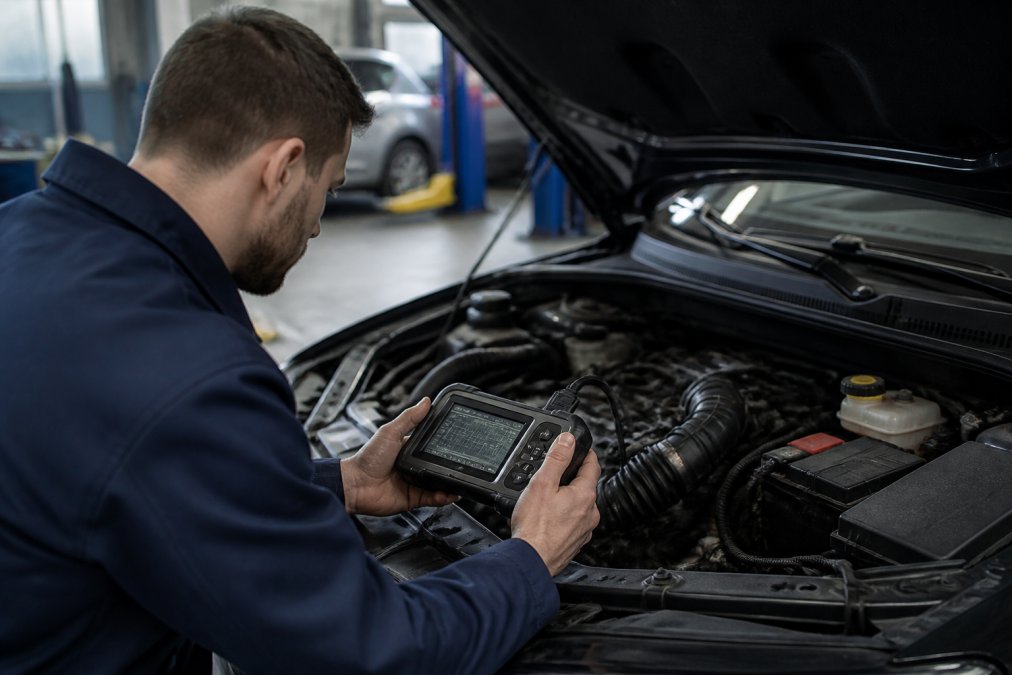
A professional diagnostic test connects a shop-grade scan tool to your vehicle's diagnostic port, pulls stored and pending codes, then reads live sensor data while the engine runs. The technician isn't just reading codes; they're watching how the systems behave in real time.
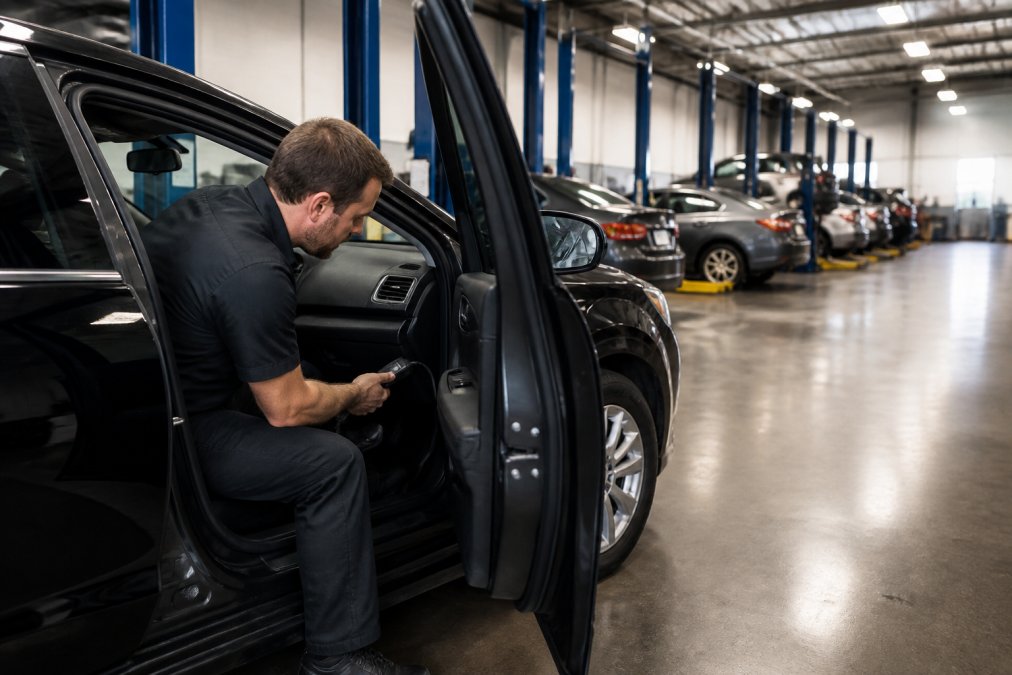
The process usually looks like this:
- Plug the scan tool into the OBD2 port under the dash
- Pull all stored, pending, and permanent fault codes
- Review freeze-frame data captured when the fault occurred
- Run live data streams on suspect sensors and systems
- Test components directly to confirm the cause
- Document findings and recommend the fix
The data stream step is where cheap scans fall short. Live readings show whether a sensor is lazy, dead, or being fooled by something upstream.
OBD2 Scanners vs. Professional Diagnostic Software
An OBD2 scanner reads generic codes. A professional scan tool reads manufacturer-specific codes, bidirectional controls, and module data a basic reader can't touch. A consumer scanner might show "P0171: system too lean." A shop tool can command the fuel pump, watch fuel trim, and test the mass airflow sensor in the same session.
That gap matters when the code is vague. Generic readers are a fine starting point. They are not a diagnosis.
How Long Does a Car Diagnostic Take?
A basic diagnostic scan takes 30 to 60 minutes. A full diagnostic that includes road testing and live data analysis can take two to three hours. The difference is depth, not speed.
Simple code reads finish fast because the tool does all the work. Real diagnosis takes longer because a technician has to confirm the cause. That means checking wiring, testing sensors, and sometimes driving the car to reproduce the fault.
If your shop quotes a same-day answer, ask what's included. A quick scan and a proper diagnosis are not the same service. Expect a longer visit when the problem is intermittent, since those faults can hide for hours before showing up.
How Much Does a Car Diagnostic Test Cost?
Diagnostic pricing depends on the shop, the vehicle, and how deep the technician has to dig. Most independent shops charge a flat diagnostic fee, while dealerships often bill by the hour at their posted labor rate. A common pattern is a one-hour minimum diagnostic charge, with additional time billed if the fault is intermittent or spans multiple systems. Many shops apply the fee toward the repair if you approve the work, which changes the math on your total bill.
A few things move the price:
- Vehicle make and model, since some brands require manufacturer-specific software subscriptions or special adapters
- Whether the issue is a simple stored code or an intermittent fault that has to be reproduced
- How many systems need testing (engine only vs. engine, transmission, ABS, and body modules)
- Whether the shop credits the diagnostic fee toward the repair
- Whether the vehicle needs a road test or a relearn procedure after the fix
The Federal Trade Commission guidance on auto repair notes that you're entitled to a written estimate before work begins, and that estimate should separate the diagnostic charge from the repair cost. Ask for that breakdown in writing. If a shop won't put the diagnostic fee and the credit policy in the estimate, treat that as a red flag.
| Question | What to Expect |
|---|---|
| Basic scan time | 30-60 minutes |
| Full diagnosis time | 2-3 hours |
| Fee credited to repair | Varies by shop, ask first |
| What you get | Codes, freeze-frame data, live readings, and a written repair plan |
| Typical billing basis | Flat fee or hourly at the shop's posted labor rate |
One cost most guides skip: the price of not diagnosing. Replacing a part based on a code alone often means paying for a part you didn't need, then paying again when the light returns. A vacuum leak that triggers an oxygen sensor code, for example, will not be fixed by a new sensor.
For current pricing at Kerner's Auto, contact our team for a quote.
Interpreting Diagnostic Trouble Codes and What They Mean
A diagnostic trouble code is a standardized code that identifies which system logged a fault and what kind of problem it detected. Codes start with a letter (P for powertrain, B for body, C for chassis, U for network) followed by four digits.
Preventative vs. Reactive Diagnostics: Which Approach Saves More?
Think about the difference in practice:
- Preventative: scan during routine service, catch a failing sensor early, fix it for a modest cost
- Reactive: ignore the warning light, drive until the car fails, pay for towing plus a bigger repair
That's the case for why car diagnostic tests are necessary. They turn guesswork into a clear repair plan, and they protect your wallet from problems that grow while you wait.
Frequently Asked Questions
How much does a full car diagnostic cost?
The cost of a car diagnostic test varies depending on the shop, the vehicle's make and model, and the complexity of the issue. At Kerner's Auto, pricing depends on the specific diagnostic service needed. Some shops charge a flat fee, while others apply the diagnostic fee toward the repair if you proceed with the work. Always ask about the shop's diagnostic fee structure and whether it's credited toward repairs before you authorize any work.
What are the disadvantages of diagnostic tests?
Diagnostic tests are highly accurate but not infallible. A scan tool reads fault codes, but it cannot always pinpoint the exact failed component. For example, an oxygen sensor code might point to the sensor itself or to a wiring issue or exhaust leak upstream. This is why professional diagnosis by an ASE-certified technician matters. A skilled technician interprets error codes alongside real-time data, vehicle health reports, and physical inspection to confirm the true cause before recommending repairs.
What are signs that my car needs a diagnostic?
Common signs include a check engine light, dashboard warning indicators, unusual noises, rough idling, decreased fuel economy, or a vehicle that fails an emissions compliance check. You might also notice transmission fluid leaks, brake system irregularities, or sensor failure symptoms like erratic gauge readings. If your car exhibits any of these, a diagnostic test can identify the root cause before a minor issue becomes a major repair.
Can a diagnostic test find every car problem?
No. A diagnostic test excels at identifying issues within a vehicle's electronic control modules, sensors, and emissions systems. It cannot detect mechanical problems like worn brake pads, a failing water pump, or a cracked exhaust manifold unless those issues trigger a sensor or affect engine performance. That's why a thorough vehicle health report combines diagnostic data with a hands-on inspection by a qualified technician.
Don't let a warning light turn into a roadside breakdown. Get a proper diagnosis from Kerner's Auto, where advanced diagnostic technology and honest answers have kept drivers on the road since 1973. Make an appointment and get a clear repair plan today.