 How-to
5 Reasons Your Car Clicks When Starting (and What to Do)
Last Updated: November 12, 2026
Quick Summary
A clicking noise when starting a car usually points to the starting system, which includes the battery, cables, starter motor and solenoid. Rapid clicking most often means a weak battery or loose, corroded terminals, while a single loud click often points to a starter problem.
- Rapid clicking usually means the solenoid lacks enough power to crank the engine.
- Dimming dashboard lights when you turn the key point to the battery or a connection.
- Twist each battery clamp by hand; a clamp that moves needs tightening.
- Disconnect the negative (black) cable first and reconnect it last.
- Most batteries last about three to five years.
Table of Contents
- What the Clicking Sound Is Telling You
- Rapid Clicking Sound When Starting Car
- Single Click When Trying to Start Car
- Car Won't Start Just Clicks but Battery Is Good
- Clicking Noise When Starting Car but Radio Works
- A Safe Step-by-Step Diagnostic Flow
- Booking Your Diagnostic Visit at Kerner's Auto
- Frequently Asked Questions
What the Clicking Sound Is Telling You
A clicking noise when you turn the key is one of the most common car problems drivers face. The sound usually points to the starting system, which includes the battery, cables, starter motor, and solenoid.
When you turn the key, the battery sends power to the starter, which cranks the engine.
Pay attention to two things: whether you hear one click or many, and whether the dashboard lights stay on. Those clues narrow the cause quickly.
Rapid Clicking Sound When Starting Car
A rapid clicking sound usually means the starter solenoid is trying to engage but does not have enough power to crank the engine. The solenoid opens and closes very fast when voltage drops.
In most cases, this points to a weak battery or a poor electrical connection. If the dashboard lights and headlights dim sharply when you turn the key, the battery is the likely culprit.
Here are the most common causes of rapid clicking:
- A dead or weak battery
- Loose or corroded battery terminals
- A battery that is old and no longer holds a full charge
Dead or Weak Battery
A battery is the most frequent cause of rapid clicking. Batteries lose strength over time, and cold weather makes the problem worse.
A simple test helps. Turn on your headlights and try to start the car.
Some auto parts stores offer battery testing, which can confirm the problem before you spend money on parts. A jump-start can get you going, but it does not fix a failing battery.
Loose or Corroded Battery Terminals
Loose or corroded terminals stop power from flowing well to the starter.
Turn the car off and make sure all accessories are off.
Watch out: always disconnect the negative (black) cable first and reconnect it last. Wear gloves and eye protection, since battery acid can burn skin and eyes.
The common causes of rapid clicking, and what each one looks like, are summarised below.
| Cause | Key sign | Quick check |
|---|---|---|
| Dead or weak battery | Lights dim sharply when you turn the key | Headlights test: bright and steady means the battery is probably fine |
| Loose or corroded terminals | White, blue, or green crust; clamp moves by hand | Twist each clamp; a loose clamp needs tightening |
| Old battery | Near the end of its life | Check age and state of charge |
| Poor ground connection | Engine to chassis path is weak | Check the ground connections |
Single Click When Trying to Start Car
A single, loud click can mean the solenoid is engaging but the starter motor is not spinning. The battery may have enough charge to pull in that one click, but the starter does not get enough current to turn the engine.
Unlike rapid clicking, a single click often happens even when the battery is in decent shape. The solenoid is a heavy-duty relay that pushes the starter drive gear into the flywheel and closes the high-current contact that spins the motor.
Faulty Starter Motor or Solenoid
The starter motor or the solenoid can wear out over time. When the solenoid clicks but the motor does not turn, the starter is the likely cause.
A technician can test the starter circuit to confirm the fault, checking battery voltage, voltage at the solenoid command terminal, and voltage drop on the cables under load. Because weak battery output can also distort voltage readings under load, the car battery maintenance guide offers a useful next step for keeping the supply reliable.
Repair or replacement depends on what testing shows, so a professional diagnosis is the safest route. Repair costs depend on the specific vehicle and what the diagnosis reveals, so confirm with a written estimate before authorizing work.
Single Click Versus Other One-Time Noises
Not every single click is a starter fault. A click from under the dash can be a relay in the starting circuit, and a click from the engine bay that repeats once per second can be a battery management or security system cycling. A single heavy clunk that coincides with a brief crank and then silence is more consistent with a starter drive that is not engaging the flywheel.
Can You Drive With a Single Click?
If the engine starts after the click, the vehicle is generally drivable, but a starter that is beginning to fail can leave you stranded without warning. If the engine does not start and you hear only the single click, do not keep cranking; repeated attempts can overheat the starter and drain the battery.
Watch out: never bridge the starter terminals with a screwdriver or wrench to test it. That bypasses the neutral safety circuit and can cause the vehicle to lurch or start in gear.
Car Won't Start Just Clicks but Battery Is Good
Sometimes the battery tests fine, yet the car still just clicks. A battery can show a good resting charge and still struggle to deliver enough current under load.
Other causes can lead to this symptom: a poor ground connection blocking the return path for current, a failing starter, a bad solenoid, or a damaged starter circuit.
Here is a simple way to think about it: if the battery reads well but the car still clicks, check the connections, then have the starter and starter circuit tested.
Clicking Noise When Starting Car but Radio Works
When the radio works but the car clicks, the battery probably has enough charge to power small electronics.
This is a common pattern with an aging battery: accessories use little power, so the battery seems fine until you ask it to crank the engine.
Also look at the cable connections. A loose connection can allow the radio to run while cutting off the high current the starter needs.
A Safe Step-by-Step Diagnostic Flow
Work through these steps in order. Stop if you find something that needs a professional, and wear appropriate safety gear. Learn why car diagnostic tests are necessary before repairs.
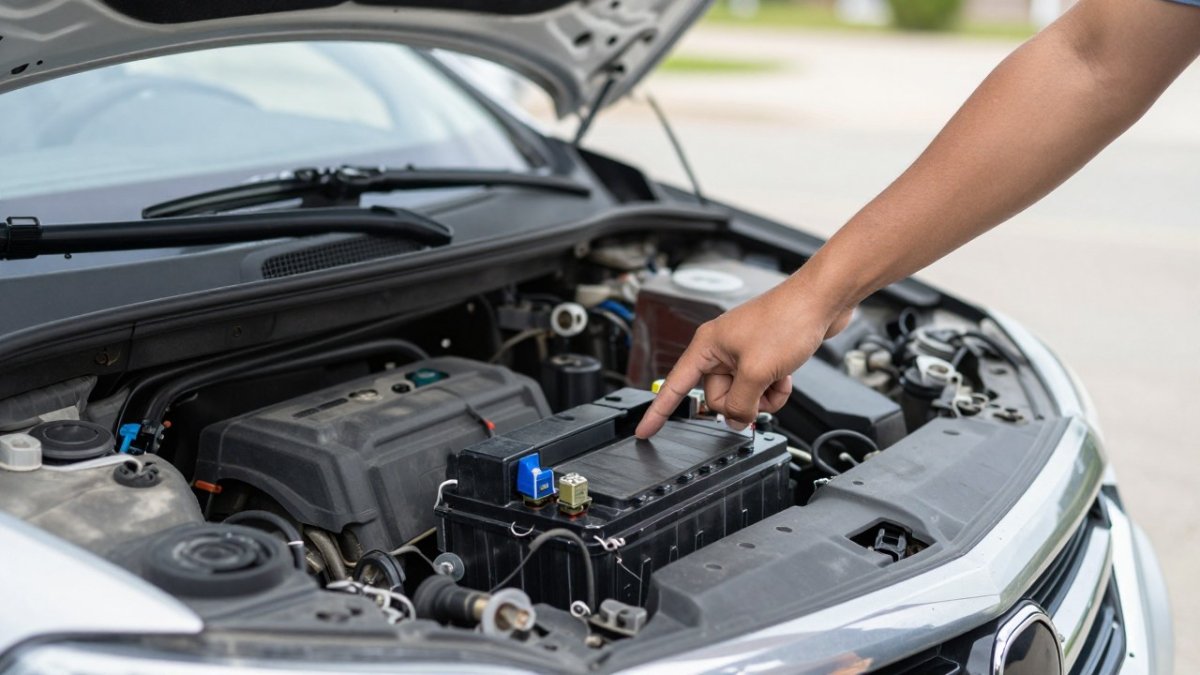
Before you touch anything: put on safety glasses and nitrile or rubber gloves. A lead-acid battery can vent hydrogen gas, and a spark near the battery can cause an explosion. Remove rings, watches, and metal jewelry.
- Listen closely and note the pattern. One click, rapid clicking, or a click followed by a brief crank each point in a different direction. Write down what you hear so you can describe it accurately to a technician.
- Check the dashboard lights and headlights. Dimming or going out when you turn the key points to the battery or a connection. Bright, steady lights that stay on while the car clicks point toward the starter circuit.
- Inspect the terminals and cables. Look for loose clamps and the white, blue, or green crust of corrosion. Twist each clamp by hand; a clamp that moves needs tightening. Clean corrosion with a wire brush and a baking soda and water paste, rinse with clean water, and dry before reconnecting. Disconnect the negative (black) cable first and reconnect it last.
- Check the battery's age and state of charge. Most batteries last about three to five years. If yours is near the end of that window and the clicking started in cold weather or after a stretch of short trips, low charge is the leading suspect. A battery that reads about 12.6 volts at rest is generally considered fully charged, while readings substantially lower suggest it may need charging or testing.
- Try a jump-start only if the battery is not damaged, leaking, cracked, or frozen. Connect the red cable to the dead battery's positive post, then the red cable to the good battery's positive post, then the black cable to the good battery's negative post, and finally the black cable to a clean, unpainted metal ground on the dead vehicle, away from the battery. Start the good vehicle, let it run a few minutes, then try the dead vehicle. Remove the cables in reverse order.
- Get the battery tested under load. Many auto parts stores test batteries at no charge. A load test is more informative than a voltage reading alone because it shows how the battery behaves when the starter asks for a large burst of current.
- Have the starter and charging system checked. If the battery and connections are good, the starter, solenoid, or charging system is the next suspect. A technician can check voltage drop across the cables and confirm whether the alternator is keeping up.
If the Jump-Start Does Not Work
A failed jump-start is a useful diagnostic result, not a dead end. Work through this decision tree:
- No change at all, still rapid clicking: the jumper cables may not be making good contact, or the dead battery is too far gone to accept a charge. Recheck the clamp connections, especially the ground clamp on bare metal, and try again after a few minutes.
- Single click, no crank, even with the good vehicle running: the battery is likely not the problem. Suspect the starter, solenoid, or a cable with high resistance. Stop jump-starting and arrange diagnosis.
- Engine cranks slowly but will not catch: the battery may be receiving charge but the engine has a separate fuel or ignition problem. Stop cranking to protect the starter.
Temperature and Driving Habits Matter
Cold weather reduces a battery's available cranking amps, and engine oil thickens, so the starter has to work harder at exactly the moment the battery has less to give. Repeated short trips are the other common contributor: the alternator may not run long enough to replace the charge used at each start, so the battery slowly walks down over weeks.
Clicking While the Engine Is Already Running
Startup clicks come from the starting circuit. A click that continues after the engine is running, or that appears while driving, is usually a different system: an air-conditioning compressor clutch, a cooling fan relay, a belt or pulley, or an accessory.
Watch out: never jump-start a vehicle with a damaged, leaking, cracked, or frozen battery, and never lean over the battery while connecting the final ground cable, since that last connection is where a spark is most likely.
Booking Your Diagnostic Visit at Kerner's Auto
If the steps above do not reveal the cause, it is time for a professional diagnosis. Our team provides professional diagnostic services designed to identify issues and help keep your vehicle running safely and reliably. We serve Shelby Township and nearby areas, and we offer complimentary shuttle service and loaner cars so you can keep moving while we work. Find out whether we serve your location in Rochester Hills.
Our team can explain what we find and what it will take to fix it. Pricing depends on the repair needed, so we give you a clear quote before any work begins, and our finance team can discuss flexible payment options if a larger repair comes up.
Ready to get your car checked? Make an appointment with Kerner's Auto today, and let our team find the source of the clicking and get you back on the road.
Frequently Asked Questions
Why does my car start but make a clicking sound?
A clicking sound while the engine runs usually points to a different component than a no-start clicking sound. Rapid clicking that appears only in the moment of cranking often means the battery or a connection is struggling to deliver enough current. If the engine starts and then you hear clicking while driving, check the alternator and drive belt, since a failing charging system can leave the battery undercharged. A shop can load-test the battery and check the charging output to narrow it down quickly.
Does a clicking noise mean the starter is bad?
Not always. A single loud click with no cranking can point to a failing starter motor or solenoid, but a weak battery or poor terminal connection produces the same sound. Because the causes overlap, a battery and charging test should come before replacing the starter. Testing the starter circuit with a voltage check at the solenoid helps separate the two problems and avoids paying for a part you do not need.
Why does my car click when starting in cold weather?
Cold temperatures reduce battery output and thicken engine oil, so the starter needs more power to turn the engine over. A battery that is already aging may have enough charge in mild weather but fall short on a cold morning, producing rapid clicking. Battery age is a common reason cold-weather starting problems appear. Testing battery voltage and cranking strength before winter is a practical way to prevent a no-start day.