 Listicle
How to Choose ASE-Certified Shops for Reliable Repairs
Last Updated: October 28, 2026
Quick Summary
ASE-certified shops offer benefits that affect your wallet, including fewer repeat repairs, faster diagnosis, accurate estimates, and correct parts the first time. Certification confirms a technician has passed standardized testing and meets work-experience requirements in a specific repair area. Verify both shop-level recognition and the individual technician's current credential before authorizing work.
- Ask for the ratio of certified to uncertified staff, since one certified technician among five uncertified is not the same.
- Check the expiration date on any displayed certificate, because an expired certificate says nothing about current standards.
- Use the official ASE lookup rather than a plaque, asking for the technician's name and certification number.
- Confirm the credential area matches your repair by asking which technician will work on your vehicle.
- Ask what happens if the repair does not fix the problem, including who inspects the vehicle and whether you pay for re-diagnosis.
Table of Contents
- What ASE Certification Actually Means for Your Repair
- 7 Benefits of ASE-Certified Shops That Affect Your Wallet
- How to Verify ASE Certification Before You Hand Over the Keys
- Questions to Ask an Auto Repair Shop Before Authorizing Work
- Red Flags When Choosing an Auto Repair Shop
- ASE Certification vs. Manufacturer Certification: Which Matters More
- What ASE Certification Does Not Guarantee
- Book Your Next Service with an ASE-Certified Team
- Frequently Asked Questions
What ASE Certification Actually Means for Your Repair
ASE certification is a voluntary credential from the National Institute for Automotive Service Excellence that confirms a technician has passed standardized testing and meets work-experience requirements in a specific repair area. The benefits of ASE-certified shops start with this simple fact: someone independent has tested the people touching your car.
At Kerner's Auto, our technicians are ASE-certified.
There are distinct credentials for technicians and shops.
The Difference Between a Certified Technician and a Certified Shop
A certified technician holds a current, individually earned credential. A shop-level recognition is distinct from an individual technician credential.
When you evaluate a repair shop, ask about the ratio, not just the logo on the door. The ASE certification program overview explains how individual credentials work, and it's worth five minutes before your next visit.
7 Benefits of ASE-Certified Shops That Affect Your Wallet
- Fewer repeat repairs. A technician who passed certification testing is more likely to diagnose the root cause the first time, which means you don't pay twice for the same problem.
- Faster diagnosis. Credentialed techs recognize patterns quickly. Less diagnostic labor on the invoice means a lower bill.
- Accurate estimates. Shops that invest in certified staff tend to have better inspection processes, so the quote you approve resembles the invoice you pay. Before you pay, learn how to verify car repair quotes line by line.
- Correct parts the first time. Certification areas include parts specialization, which reduces wrong-part installs and return visits.
- Fewer comebacks. ASE itself frames reduced comebacks as a shop-level benefit of certification, and comebacks are exactly what drain a repair budget.
- Clearer explanations. Certified technicians are tested on communication standards as part of professional practice, so you get a plain answer about what failed and why.
- Documented accountability. A credential that requires continuing education to renew signals a shop that tracks standards rather than coasting.
Accurate Diagnosis and Fewer Repeat Repairs
Diagnosis is where money quietly disappears.
If repeat problems have burned you before, our explanation of why the same car problems keep coming back covers the usual culprits.
How to Verify ASE Certification Before You Hand Over the Keys
The goal is to confirm two separate things: that the shop holds current shop-level recognition, and that the individual technician assigned to your repair holds a current credential in the relevant area.
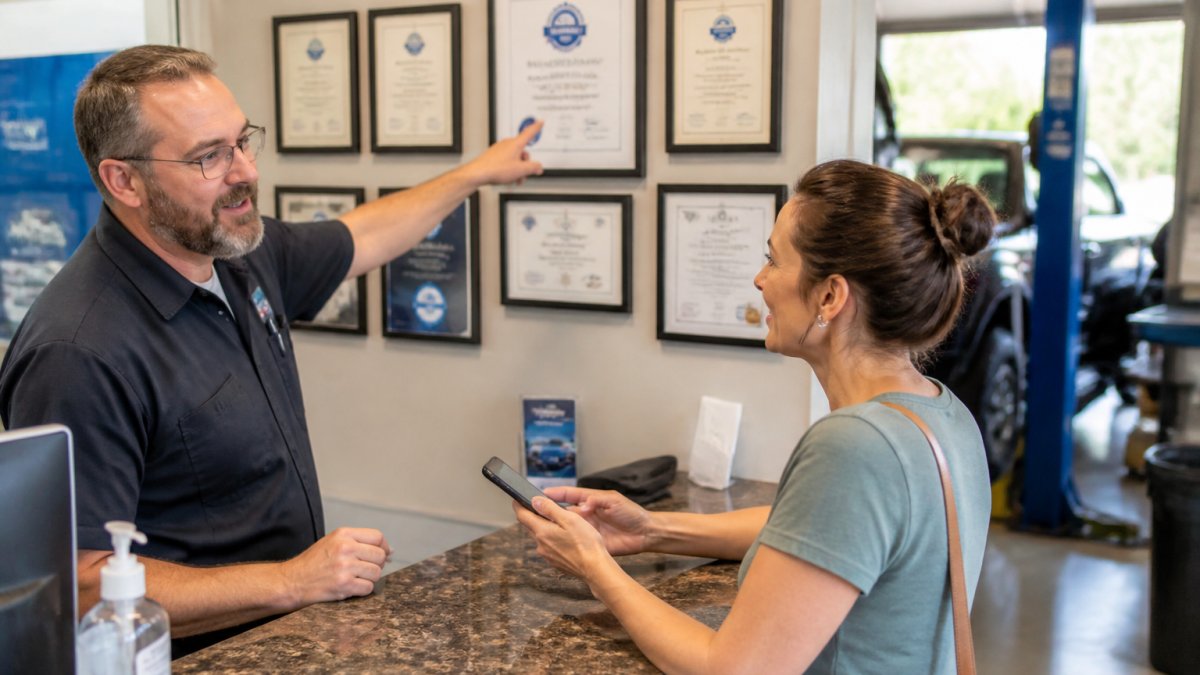
Here is a practical sequence you can run before authorizing work:
- Ask for the shop's ASE recognition status. Shop-level recognition is distinct from individual technician certification.
- Confirm the credential area matches your repair. Ask which technician will work on your vehicle and which area their current credential covers.
- Check the expiration date on any displayed certificate. Certificates renew on a cycle, and an expired certificate tells you nothing about current standards. Look at the date, not just the frame.
- Use the official ASE lookup rather than relying on a plaque. The ASE certification program overview provides the authoritative way to confirm individual and shop status. Ask the shop for the technician's name and certification number, then confirm it directly.
- Ask about the ratio of certified to uncertified staff. A shop with one certified technician and five uncertified ones is not the same as a shop where most of the team is credentialed. The ratio tells you what your odds are of actually getting a certified technician on your job.
- Ask whether the shop holds any additional recognitions. Some shops participate in ASE's shop-level recognition programs or hold manufacturer-specific certifications. These are additive signals, not substitutes for the core credential.
Verification is about replacing a general impression with specific facts you can act on.
Run through these checks before you authorize any work on your vehicle.
| Step | What to do | Why it matters |
|---|---|---|
| 1 | Ask for the shop's ASE recognition status | Shop-level recognition is distinct from technician certification |
| 2 | Confirm the credential area matches your repair | Ask which technician will work and their credential area |
| 3 | Check the expiration date on displayed certificates | An expired certificate says nothing about current standards |
| 4 | Use the official ASE lookup, not a plaque | Ask for technician name and certification number |
| 5 | Ask the ratio of certified to uncertified staff | The ratio tells you your odds of getting a certified tech |
| 6 | Ask about additional recognitions | Shop-level or manufacturer certifications are additive signals |
Questions to Ask an Auto Repair Shop Before Authorizing Work
The questions below are designed to be asked before you sign anything, and they cover diagnosis, credentials, cost, and recourse.
1. What failed, and how do you know?
If the answer is vague or relies on "it's probably the...", ask for the specific test that confirmed the diagnosis.
2. Which technician will work on my vehicle, and what are their credentials?
Ask for the technician's name and the ASE certification area relevant to your repair.
3. What is the out-the-door cost, and what could change it?
Ask for a written estimate with line items for parts and labor. Then ask what conditions would cause the final bill to exceed the estimate, such as seized bolts, additional failed components found during disassembly, or diagnostic time that exceeds the quoted amount.
4. What warranty covers the work, and for how long?
5. What happens if the repair does not fix the problem?
Ask the shop to describe its process for a comeback: who inspects the vehicle, whether you pay for re-diagnosis, and how disputes are handled.
6. Can I have the old parts back?
7. Will you show me the failed component?
For a deeper list, this guide to key questions to ask before car repair walks through each one with the reasoning behind it. Authorization is your use point, and it disappears once the work begins.
Red Flags When Choosing an Auto Repair Shop
Consider whether a shop will put an estimate in writing, tell you who is working on your car, and give you time to understand work before approving it.
Other signals worth noting:
- No visible credentials anywhere, and vague answers when you ask
- Estimates given verbally with no line items
- Reluctance to show you the failed part
- Add-on recommendations that appear only after the vehicle is on the lift
Screening shops before you need one is easier than screening during a breakdown. Our step-by-step guide on how to choose a mechanic covers the full vetting process.
ASE Certification vs. Manufacturer Certification: Which Matters More
When you're comparing, ask which certifications apply to your specific make and model rather than treating either credential as a blanket answer.
What ASE Certification Does Not Guarantee
Two things to confirm alongside credentials: the warranty terms in writing, and the shop's process for handling a repair that doesn't hold. Those two details tell you more about recourse than any certificate on the wall.
Book Your Next Service with an ASE-Certified Team
Our ASE-certified technicians work in a nine-bay facility with advanced diagnostics for all makes and models, and we've been family owned and operated since 1973. Complimentary shuttle service and loaner cars are available, and flexible financing through Synchrony Car Care is available.
Then make an appointment.
Frequently Asked Questions
Does ASE certification guarantee quality repairs?
No. ASE certification does not guarantee a specific repair outcome. Ask the shop about its policies before authorizing work.
How can I verify whether a mechanic is ASE certified?
Ask the shop directly which technicians hold ASE credentials. Kerner's Auto has ASE-certified technicians.
Should I choose an ASE-certified shop for routine maintenance?
ASE certification is one factor to consider when choosing a shop for routine maintenance. You can also ask about convenience, pricing, and inspection reports.
What are the red flags when choosing an auto repair shop?
You can ask a shop about written estimates, approvals, warranty terms, and staff credentials before authorizing work.